Download
1 / 9
100 likes | 226 Vues
This guide explores Dalton’s Law of Partial Pressures, which states that the total pressure of a gas mixture is the sum of the individual partial pressures. It delves into gas stoichiometry, a method for calculating gas volumes in chemical reactions, and highlights the importance of molar volume for converting between liters and moles. The Ideal Gas Law (PV=nRT) is also discussed for finding moles and gas properties at standard temperature and pressure (STP). A practical example shows how to determine the mass of sodium needed to produce hydrogen gas from a reaction with water.

E N D
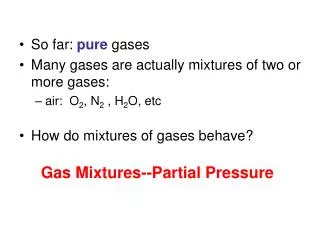
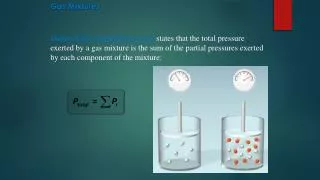
Gas Mixtures Dalton’s law of partial pressurestates that the total pressure exerted by a gas mixture is the sum of the partial pressures exerted by each component of the mixture:
Gas Stoichiometry • Many chemical reactions involve gases as a reactant or a product • Gas Stoichiometry – the procedure for calculating the volume of gases as products or reactants • Gases also have a molar volume (L/mol) rather than concentration. • This is the conversion factor used to convert (litres of gas) to (moles of gas) • The Ideal Gas Law (PV = nRT) may also be required to: A) find the number of moles of reactant B) Find the V, P, or T of the product
Example: • Hydrogen gas is produced when sodium metal is added to water. What mass of sodium is necessary to produce 20.0L of hydrogen at STP? • Remember: 22.4L/mol for STP 2Na(s) + 2H2O (l) 2NaOH(aq) + H2(g) m = ? V = 20.0L 22.99g/mol 22.4L/mol 20.0L x 1 mol x 2mol x 22.99g = 41.1 g Na(s) 22.4 L 1 mol 1 mol **Remember – molar volume is the conversion factor for gases just like molar mass is the conversion factor in gravimetric stoichiometry