
SlideServe
Menu
Préférences
© SlideServe · v2026

Primary Sources: Radio Clips

kailey avatar
10 diapositives · 207 Views · Jul 26, 2014

Explore significant radio clips from Neville Chamberlain, Winston Churchill, Franklin Roosevelt, and Harry Truman. Identify speakers, dates, contexts, and analyze their impact on the bigger picture of history. Delve into post-WWII themes like the Cold War, power struggles, and Europe's recovery efforts. Gain visual insights into American and world history's interconnected post-war challenges.
Primary Sources: Radio Clips - slide 1
01 / 10Primary Sources: Radio Clips
1 / 17

Télécharger la présentation

Primary Sources: Radio Clips
Une image / un lien ci-dessous est fourni (tel quel) pour télécharger la présentation

Politique de téléchargement : le contenu du site vous est fourni TEL QUEL pour votre information et votre usage personnel ; il ne peut être vendu, concédé sous licence ni partagé sur d’autres sites sans l’accord de son auteur.Le contenu vous est fourni TEL QUEL, pour votre information et votre usage personnel uniquement. Téléchargez la présentation en cliquant sur ce lien. Lors du téléchargement, si vous ne parvenez pas à télécharger une présentation, l’éditeur a peut-être supprimé le fichier de son serveur.Pendant le téléchargement, si vous ne parvenez pas à obtenir une présentation, le fichier a peut-être été supprimé par l’éditeur.

F I N

Plus de contenu associé

Transcription de la présentation
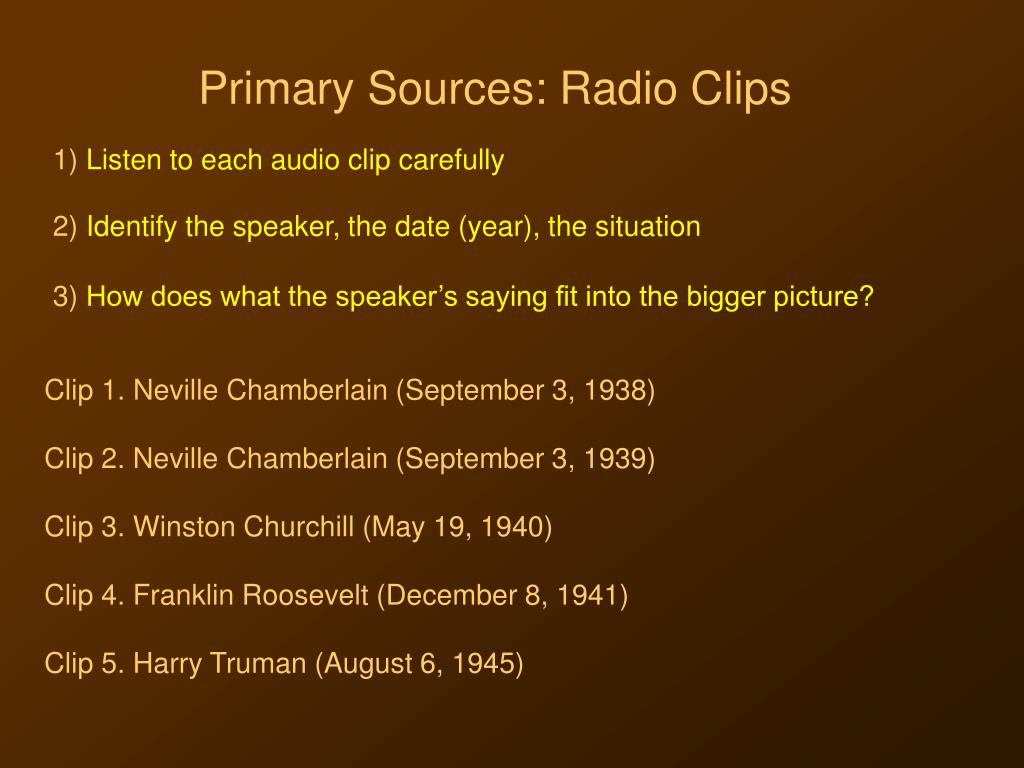
  1. Primary Sources: Radio Clips 1) Listen to each audio clip carefully 2) Identify the speaker, the date (year), the situation 3) How does what the speaker’s saying fit into the bigger picture? Clip 1. Neville Chamberlain (September 3, 1938) Clip 2. Neville Chamberlain (September 3, 1939) Clip 3. Winston Churchill (May 19, 1940) Clip 4. Franklin Roosevelt (December 8, 1941) Clip 5. Harry Truman (August 6, 1945)

  2. European Theater Pacific Theater

  3. Cold War (1945-1960) 1) What is meant by the term “Cold War”? 2) What were the main issues dividing the major powers immediately after WWII? 3) In what ways did Europe recover from the war and deal with post-war problems (political, economic, social, intellectual, etc.)? Visualized American History (1952)

  4. Visualized American History (1952) 1) Pick ONE of the post-war problems above & explain it. 2) Explain how the problem you chose is connected to one of the others.

  5. Visualized American History (1952)

  6. Visualized World History (1955)