Understanding Coastal Waves: Erosion, Littoral Drift, and Beach Landforms
This overview explores the dynamics of waves and their influence on coastal landscapes. As waves approach the shore, they experience changes in wavelength, velocity, and amplitude, leading to breaking waves that create troughs and beaches. The concepts of swash and backwash are explained, along with wave refraction and its role in littoral drift, which includes beach and longshore drift. Additionally, the formation of various coastal landforms, such as spits, bars, and tombolos, is discussed, as well as the different types of coastlines shaped by erosion and sediment deposition.

Understanding Coastal Waves: Erosion, Littoral Drift, and Beach Landforms
E N D
Presentation Transcript
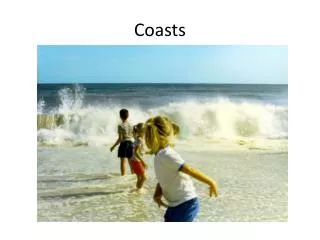
waves • Agents of erosion • as get closer to shore: • wavelength decreases • velocity decreases • amplitude increases • in shallow water, waves BREAK
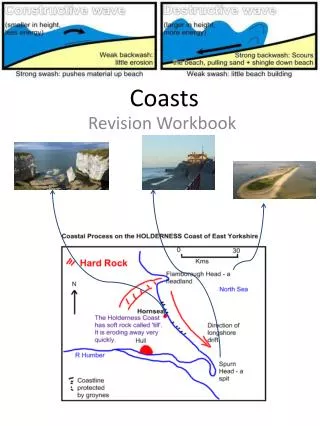
Turbulent water from breaker rushes up beach (SWASH) and then flows back (BACKWASH) • waves come in to the shore at an angle (REFRACTION)
Consequence of wave refraction • Littoral Drift • Beach drift: movement of sand particles down the beach by swash and backwash • Longshore drift: movement of particle just offshore by the longshore current (parallel to beach)
Landforms resulting from littoral drift: 1. Spit (e.g., Park Point)
Landforms resulting from littoral drift: 2. baymouth bar and lagoon
Landforms resulting from littoral drift: 3. tombolo
On an embayed coast, • Wave energy converges on HEADLANDS, and therefore erosion is concentrated there: CLIFFS • BAYS receive less energy, less erosion,and therefore deposition of sand occurs there: BEACHES
landforms on the headlands: 1. Wave-cut abrasion platforms: • sloping rock surfaces abraded by waves beneath breakers
landforms on the headlands: 2. Wave-cut notches
landforms on the headlands: 3. Sea stacks and sea arches
Where does beach sand come from? • Erosion of headlands • offshore material brought to shore • fluvial sediment
Types of coastlines 1. Ria Coast: • coast that was formerly dissected by stream valleys; then sea level rose and inundated the valleys
Types of coastlines 2. Fiord coast: • coast that was formerly dissected by glacial troughs; then sea level rose and they became inundated
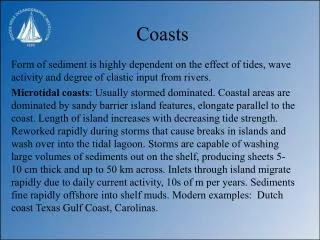
Types of coastlines 3. Barrier Island Coast: • sand bars (barrier islands) created by littoral drift, parallel shore, enclose lagoons