Geometry Concepts Illustrated with Clocks and Protractors
Explore concepts like trisection, bisection, and angle bisectors in geometry using clock angles and protractors without direct measurements. Learn key geometric properties and relationships in a visual and practical way.

Geometry Concepts Illustrated with Clocks and Protractors
E N D
Presentation Transcript
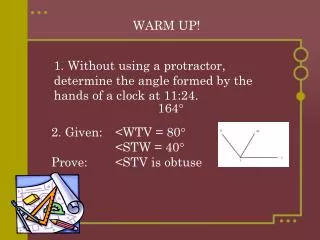
WARM UP! 1. Without using a protractor, determine the angle formed by the hands of a clock at 11:24. 164 2. Given: <WTV = 80 <STW = 40 Prove: <STV is obtuse
1.5 Division of Segments and Angles Bisection: a point (segment, ray or line) that divides a SEGMENT into two congruent segments BISECTS the segment. Midpoint: point where a line segment is bisected into 2 congruent parts.(line has to be collinear!)
If OK = KP what conclusions can you make? M O K P J Conclusions: K is the midpoint of OP JM is a bisector of OP Point K bisects OP
Trisected: Three congruent parts Trisection points: the two points at which the segment is divided into three equal parts. H Conclusions: DE = EF = FG HE and HF trisect DG E D F G
Angle Bisector: A ray that divides an angle into two congruent angles is an angle bisector. bi means two If <ABC = <CBD, then BC is the bisector of <ABD A C D B
Draw AB and AC so that each bisect <DAE Example 1: D B C A E Example 2: B E D A C
R T S If RS = ST is S the midpoint? NO! Not collinear!
If B & C trisect AD, do EB & EC trisect <AED? A E B C D Not necessarily! Only if ADE is isosceles.
Given: DH = HF Prove: H is midpoint of DF G F H D E StatementReason DH = HF 1. Given H is midpoint 2. Def: if a point divides a segment into 2 = segments, it is the midpoint.
Given: KO bisects <JKM <JKM = 41 37’ Find m<OKM Draw and label what you know! J O m<OKM = ½ m<JKM K M = ½ (41 37’) = 20½ 18½ ’ = 20 48’ 30”