Scientific Taxonomy
Explore the fascinating world of scientific taxonomy and the Tree of Life, which organizes living organisms into domains and kingdoms. Discover the characteristics of prokaryotes and eukaryotes, and learn how different life forms, from plants and fungi to animals and protists, are classified. Gain insights into arthropods and their distinctive features, along with engaging activities for sorting various types of organisms. This guide provides a comprehensive overview of biological classification that is essential for understanding biodiversity.

Scientific Taxonomy
E N D
Presentation Transcript
Scientific Taxonomy Did King Phillip Cry Out, "For Goodness Sakes!"?
Prokaryotes Archaea • Simple • No nucleus • Small Bacteria
Eukaryotes • Larger than prokaryotic cells • Have specialized structures called organelles • You are made of eukaryotic cells
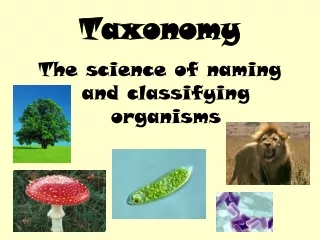
Kingdoms Kingdom Plantae Kingdom Animalia Kingdom Fungi Kingdom Protista
Protists • Protozoa, algae, slime molds • Mostly single celled (A) a diatom an autrophic protist, (B) a herbivorous oligotrich ciliate, (C) a herbivorous tintinnid ciliate, (D) a dinoflagellate, and (E) a radiolarian. Images by J.R. Dolan(From http://www.eoearth.org/article/Marine_microbes)
Plants • Cell wall, chloroplasts • Autotrophic (makes own food) • Trees, mosses, ferns
Fungi • Cell wall • Heterotrophic (cannot make own food) • Yeast, mushrooms
Animals • Motile • Heterotrophic (cannot make own food) • Worms, insects, vertebrates, “us”
Tree of Life • http://tolweb.org/tree/
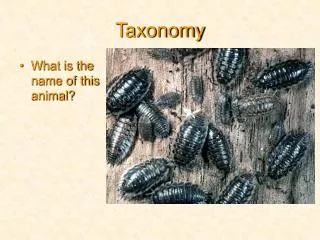
What is a bug? • Domain = Eukarya Kingdom= Animalia • Bugs belong to a phylum called Arthropoda
Characteristics of Arthropods • Bilateral symmetry • Segmented body • Hard exoskeleton • Jointed legs • Many pairs of limbs
Classes of Arthropods • Many classes • Include insects, arachnids, myriapods, and crustaceans
Activity 1 • Sort the pictures of arthropods any way you choose. • You must be able to state a reason for the categories.
Activity 2 • Sort your piles of pictures again by separating the insects from the non-insects.
Activity 3 • Sort your group of arthropods into insects, arachnids, myriapods, and crustaceans.