Download
1 / 12
120 likes | 264 Vues
This lecture explores the geomagnetic field's relationship with particle theory, focusing on the mechanics of fast and slow solar winds. Key topics include horizontal and vertical components of the geomagnetic field, magnetic indices (Kp, Dst, AE), and the behavior of solar wind particles influenced by geomagnetic forces. The material is supplemented with selected chapters from significant references, providing a comprehensive overview of gyro-motion, bounce motion, and drift motion of solar wind particles, alongside concepts such as magnetic mirroring and the loss cone.

E N D
CSI 662 / ASTR 769 Lect. 07 Spring 2007 Mainly By Bob Weigel on March 6, 2007 Supplemented By Jie Zhang on March 27, 2007 Geomagnetic Field and Particle Theory • References: • Prolss: Chap. 5.1 – 5.3, P. 209-240 (main reference) • Tascione: Chap. 1.6 – 1.12, P4 -- P9; Chap. 4.0 -- 4.7, P43 --P50 (supplement) • Gombosi: Chap. 1, P3 – P23 (supplement)
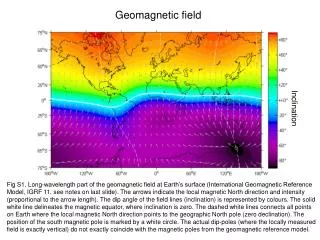
Fast and Slow Wind Earth Magnetic Field • Geomagnetic Poles • Horizontal component • Vertical component • Shell parameter • Footpoints • Curvature
Fast and Slow Wind Magnetic Indices • Measuring the variation of horizontal magnetic field • Dst index: low latitude, hourly, global network • Kp index: middle latitude (48° to 63°), 3-hour • AE index: high latitude (62° to 72°) within aurora zone, 1 minute, not global
Fast and Slow Wind Gyro-motion
Fast and Slow Wind Bounce Motion
Fast and Slow Wind Drift Motion: Gradient Drift
Fast and Slow Wind Drift Motion: Curvature Drift
Fast and Slow Wind Drift Motion: E drift • Ambipolar E X B drift
Fast and Slow Wind DPS relationship
Fast and Slow Wind Adiabatic Invariants • Periodic motion can be characterized by a conserved quantity under adiabatic condition: • General form I=∫pdq, p and q are generalized momentum and coordinate • 1. Magnetic moment invariant -- Gyromotion I = ∫pperdrg • 2. Bounce invariant I = ∫ppardspar • 3. Longitudinal drift invariant (L shell) I = ∫pdrdrdf
Fast and Slow Wind Magnetic Mirroring • Pitch angle • Mirror point • Loss cone