
SlideServe
Menu
Préférences
© SlideServe · v2026

Source

kalli avatar
17 diapositives · 378 Views · Oct 23, 2014

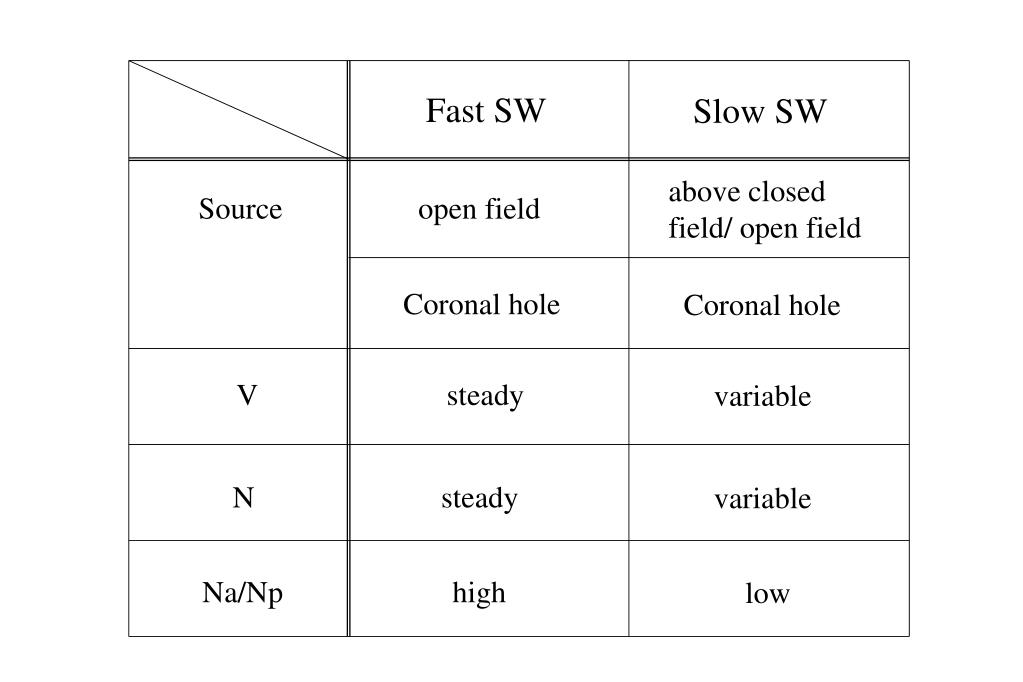
Fast SW. Slow SW. above closed field/ open field. Source. open field. Coronal hole. Coronal hole. V. steady. variable. N. steady. variable. Na/Np. high. low. Relation between speed and coronal hole area. The speed of the solar wind scales with the coronal hole area.
Source - slide 1
01 / 17Source
1 / 17

Télécharger la présentation

Source
Une image / un lien ci-dessous est fourni (tel quel) pour télécharger la présentation

Politique de téléchargement : le contenu du site vous est fourni TEL QUEL pour votre information et votre usage personnel ; il ne peut être vendu, concédé sous licence ni partagé sur d’autres sites sans l’accord de son auteur.Le contenu vous est fourni TEL QUEL, pour votre information et votre usage personnel uniquement. Téléchargez la présentation en cliquant sur ce lien. Lors du téléchargement, si vous ne parvenez pas à télécharger une présentation, l’éditeur a peut-être supprimé le fichier de son serveur.Pendant le téléchargement, si vous ne parvenez pas à obtenir une présentation, le fichier a peut-être été supprimé par l’éditeur.

F I N

Plus de contenu associé

Transcription de la présentation
  1. Fast SW Slow SW above closed field/ open field Source open field Coronal hole Coronal hole V steady variable N steady variable Na/Np high low

  2. Relation between speed and coronal hole area The speed of the solar wind scales with the coronal hole area. [Nolte et al., 1976] Intermediate and slow streams originated in smaller coronal holes at low latitudes and from open field regions just outside coronal hole boundaries. [Neugebauer et al., 1998]

  3. Solar Wind Structure at Solar Minimum

  4. potential field neutral line A neutral line does not traverse through the minimum speed locus. after Crooker et al., 1997

  5. potential field neutral line ? ? after Kojima et al., 1999

  6. The slowest wind originates from the vicinity of an active region. after Kojima et al., 1999

  7. The slowest wind originates from the vicinity of an active region. after Kojima et al., 1999

  8. MHD simulation by Linker & Mikic ’99 V V N low density low speed from coronal hole

  9. after Kojima et al., 1999 Coronal hole model Helmet streamer model

  10. Solar Wind in CR 1897 (June 12 – July 10, 1995) Parameter Slow (HPS) Slow (seCH) Fast (leCH) VP [km/s] 343±22 323±9665±13 NP [cm-3] 11.8±3.9 10.2±0.7 3.8±0.6 TP [105 K] 0.39±0.21 0.55±0.112.39±0.34 TO [106 K] 1.92±0.30 1.99±0.191.38±0.07 Nα/ NP 0.013±0.013 0.031±0.0080.040±0.004

  11. Solar Wind in CR 1897 (June 12 – July 10, 1995) Parameter Slow (HPS) Slow (seCH) Fast (leCH) VP [km/s] 343±22 323±9665±13 NP [cm-3] 11.8±3.9 10.2±0.7 3.8±0.6 TP [105 K] 0.39±0.21 0.55±0.112.39±0.34 TO [106 K] 1.92±0.30 1.99±0.191.38±0.07 Nα/ NP 0.013±0.013 0.031±0.0080.040±0.004

  12. Fast SW Slow SW above closed field/ open field Source open field Coronal hole Coronal hole V steady variable N steady variable Na/Np high low open field Coronal hole steady steady high

  13. Magnetic Field in the Coronal Holes • Polar CH : <12 G> at the poles : < 3 G> at the equatorward boundary [Svalgaard et al., 1978] • Low latitude CH : up to 15 G [Harvey and Sheeley, 1979] : 9 (2~18) G [Burlaga et al., 1978] • Polar CH (just before disappear) : <10 G> • Small equatorial CH : <18 G> [Ohmi et al., 2002] .

  14. Unipolar, steady flow, large Na/Np ⇒ Coronal hole origin T(in seCH) as high as slow wind ⇒ heating T(@1AU) as low as slow wind ⇒ Adiabatic cooling Origin of slow SW(seCH) B (in seCH) as strong as active region

  15. pCH seCH Origin of slow SW(seCH) Coronal hole origin ⇒ extra momentum source in lower corona Large NV High T(in seCH) Enhanced Heating in lower corona StrongB (in seCH)

  16. Origin of variability in (90%) slow SW Axford: changing foot points of field line as result of reconection.