Understanding Groundwater: Its Role in the Hydrosphere and the Earth's Water Cycle
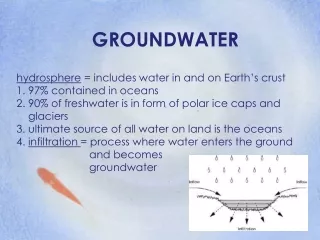
Groundwater is a crucial component of Earth's hydrosphere, representing a significant portion of the planet's freshwater resources. While 97% of Earth's water is found in oceans, only about 3% is freshwater, predominantly stored in polar ice caps, glaciers, and groundwater. Groundwater forms through precipitation infiltration and is stored in the pore spaces of rocks and sediments. It varies in level due to seasonal changes, with aquifers serving as permeable layers facilitating groundwater flow. Understanding groundwater is essential for sustainable water management and environmental conservation.

Understanding Groundwater: Its Role in the Hydrosphere and the Earth's Water Cycle
E N D
Presentation Transcript
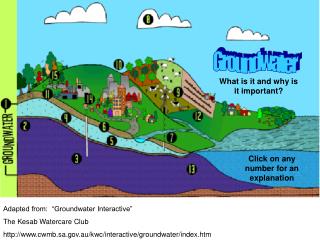
A. Hydrosphere Hydrosphere – all of the water on and in Earth’s crust • 97% oceans • 3% freshwater • 79% in polar ice caps, glaciers • Most of the rest is groundwater
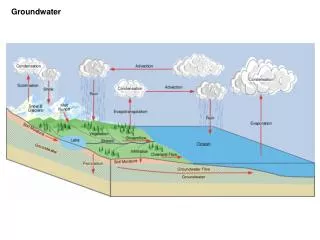
The oceans are the ultimate source of water for land • Evaporation -> cloud formation -> precipitation • MOST precip. on land infiltrates the ground & becomes groundwater • Small portions become runoff
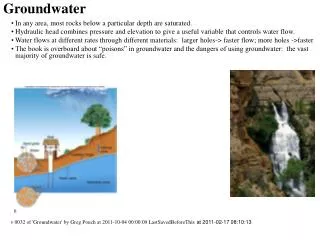
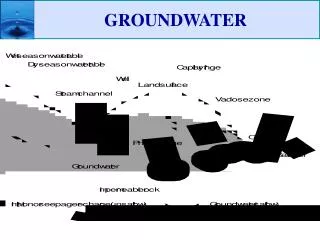
B. Where does groundwater go? 1. Infiltrates through porous Earth material 2. Stored in pore spaces of rocks and sediments a. Zone of aeration – above the water table, pores contain mostly air b. Water table – upper boundary of zone of saturation c. Zone of saturation – depth where all pores are filled with water
3. Water table level varies • Wet season = higher water table (closer to surface) • Drought = lower
4. Aquifers • permeable layer of material through which groundwater flows • Permeability – ability of a material to let water pass through a. Sand & gravel = high permeability b. Fine-grained materials (clay) = lowpermeability