

SlideServe
Menu
Préférences
© SlideServe · v2026

Interrogative Words

kameko-rojas avatar
18 diapositives · 324 Views · Nov 16, 2014

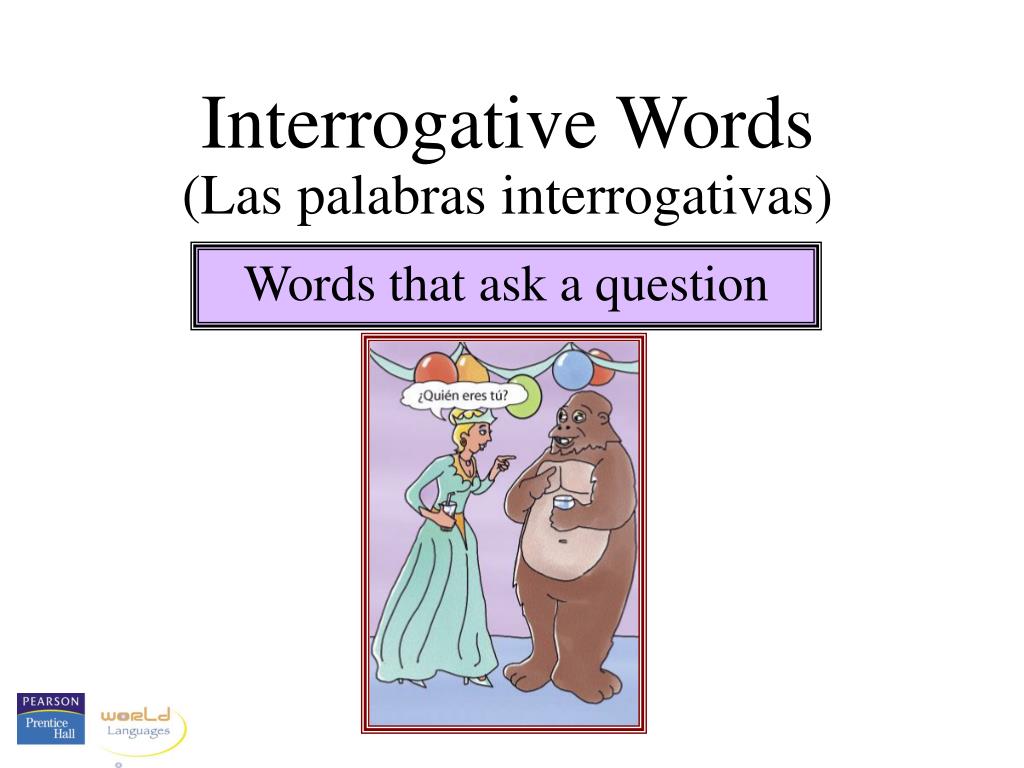
Words that ask a question. Interrogative Words. (Las palabras interrogativas). Interrogative Words. Interrogative words are vital to any language. They help us to obtain different kinds of information. ¿Cómo? = How? (sometimes what ?). ¿Cómo estás?. ¿Cómo es tu compañero de cuarto?.
Interrogative Words - slide 1
01 / 18Interrogative Words
1 / 17

Télécharger la présentation

Interrogative Words
Une image / un lien ci-dessous est fourni (tel quel) pour télécharger la présentation

Politique de téléchargement : le contenu du site vous est fourni TEL QUEL pour votre information et votre usage personnel ; il ne peut être vendu, concédé sous licence ni partagé sur d’autres sites sans l’accord de son auteur.Le contenu vous est fourni TEL QUEL, pour votre information et votre usage personnel uniquement. Téléchargez la présentation en cliquant sur ce lien. Lors du téléchargement, si vous ne parvenez pas à télécharger une présentation, l’éditeur a peut-être supprimé le fichier de son serveur.Pendant le téléchargement, si vous ne parvenez pas à obtenir une présentation, le fichier a peut-être été supprimé par l’éditeur.

F I N

Plus de contenu associé

Transcription de la présentation
  1. Words that ask a question Interrogative Words (Las palabras interrogativas)

  2. Interrogative Words Interrogative words are vital to any language. They help us to obtain different kinds of information. ¿Cómo? = How? (sometimes what?) ¿Cómo estás? ¿Cómo es tu compañero de cuarto? ¿Cuál(es)? = Which one(s)? ¿Cuál es el título de la novela? ¿Cuáles son tus novelas favoritas? ¿Cuándo? = When? ¿Cuándo es la clase de historia? All question words bear a written accent over the stressed vowel.

  3. Interrogative Words Interrogative words are vital to any language. They help us to obtain different kinds of information: ¿Cuánto/a(s)? = How much (many)? ¿Cuántos libros necesitamos? ¿Dónde? = Where? ¿Dónde está mi pluma? ¿De dónde? = From where? ¿De dónde eres? ¿Adónde? = To where? ¿Adónde vas? All question words bear a written accent over the stressed vowel.

  4. Interrogative Words Interrogative words are vital to any language. They help us to obtain different kinds of information: ¿Por qué? = Why? ¿Por qué estás tan triste? ¿Qué? = What? ¿Qué aprendes en la clase de español? ¿Quién(es)? = Who (all)? ¿Quién tiene el libro? ¿De quién(es)? = Whose? ¿De quién es la mochila negra? All question words bear a written accent over the stressed vowel.

  5. Question marks (Signos de interrogación) An inverted question mark (¿) is always placed at the beginning of a question word or phrase, and another right-side-up question mark at the end. Pardon? How’s that again? ¿Cómo? ¿Cómo es tu profesor? What is your professor like? While in English, word order or the helper verb do normally indicate a question, in Spanish, word order for questions and statements can be identical, and Spanish has no equivalent to the helper verb do. Thus the inverted question mark alerts the reader that a question follows. ¿Juan habla inglés? Does Juan speak English? Juan habla inglés. Juan speaks English.

  6. Expansión ¿Qué? vs. ¿Cuál? What? Which? Which one(s)?

  7. ¿Qué? = What? «¿Qué?» asks foradefinition, identification orclassification. ¿? What is chemistry? ¿Qué es la química? Es el estudio de la composición elemental de la materia. (It’s the study of the elemental composition of matter.)

  8. ¿Qué? = What? «¿Qué?» asks foradefinition, identification orclassification. ¿? What is this? ¿Qué es esto? Es un teléfono celular. (It’s a cell phone.)

  9. ¿Qué? = What? Es el software para tu computadora. ¿Qué tienes en la mano? It’s the software for your computer. What do you have in your hand?

  10. ¿Qué? = What? ¿Qué es él, hondureño o peruano? What is he, Honduran or Peruvian? ¿Qué? asks for a classification such as nationality, political affiliation orreligion, etc. ¿Qué son tus padres, católicos o protestantes? What are your parents, catholic or protestant?

  11. ¿Cuál? = Which (one)? «¿Cuál?» asks for a selectionfrom among several things. Which is the prettiest flower (of all)? ¿Cuál es la flor más bonita? Cuando se trata de los deportes, ¿cuál prefieres, el fútbol o el básquetbol? When it comes to sports,which (one) do you prefer, soccer or basketball?

  12. ¿Cuál? = Which (what)? (Remember: ¿Qué? asks for a definition.) Pilar For example: In Spanish we say . . . Alicia Teresa “What is your name?” “Which is your name?” ¿Cómo se dice Timoteo Miguelito Francisco ¿Cuál? is sometimes translated into English aswhat, but logically it still meanswhich. Magdalena ¿Cuál es tu nombre? Alfredo Vicente Eduardo Of all possible names, which one is yours? ¿Qué es tu nombre? would mean“What is the definition of your name?”

  13. ¿Qué?, ¿Cuál(es)? —¿Qué película vas a ver? Which movie are you going to see? — ¿Qué películas te gustan más? Which movies do you like the best? ¿Qué? is always invariable. ¿Cuál? has a plural form. —¿Cuál de los muchachos es tu hermano? Which of the boys is your brother? — ¿Cuáles de los muchachos son chilenos? Which of the boys are Chilean?

  14. ¿Cuál? = Which? ¿Cuál? asks for a selection, as mentioned. —¿Cuál es la mejor computadora? Which (of all the computers) is the best?

  15. ¿Qué? = Which? before a noun But immediately before anoun, ¿qué? is used in all cases. ¿Qué modelo prefieres tú, Faido?

  16. ¿Cuál? before a noun —¿Cuálchaqueta trajiste, la roja o la negra? (¿Quéchaqueta . . . ?) Nevertheless, even though some consider it grammatically questionable, somenative speakers tend to use ¿cuál? in these casesand, in informal circumstances, even the most scholarly may use it. Which jacket did you bring, the red one or the black one?

  17. ¿Cuál? before a noun —¡Oye! Dame el dinero que me debes, ¿eh? Hey! Give me the money you owe me, OK? The foregoing is especially common when dealing with an exclamation of surprise or incredulity, etc. —¡¡¿Cuáldinero?!! ¡Yo no te debo ningún dinero! What money?!! I don’t owe you any money! (—¡¡¿Quédinero . . . ?!!)

  18. FIN