Download
1 / 11
110 likes | 216 Vues
This presentation by Casey Law delves into the capabilities of LOFAR’s prototype Core Station 1 (CS1) for detecting transient radio sources. Located in the LOFAR core, CS1 features 96 low-band (LBA) and high-band antennas (HBA) and is designed for both commissioning and scientific observation. Early results from observations at frequencies between 10-90 MHz suggest a promising architecture for conducting all-sky imaging surveys. The talk highlights the Radio Sky Monitor (RSM), transient detection pipelines, and the importance of public access to data, emphasizing the potential of LOFAR in advancing our understanding of transient radio phenomena.

E N D
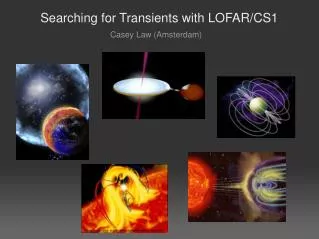
Searching for Transients with LOFAR/CS1 Casey Law (Amsterdam)
You know LOFAR... What is CS1? Possible layout of LOFAR stations Low-band antenna in CS1 • Core Station 1 is a prototype LOFAR station • Located in LOFAR core • 96 LBAs and HBAs
Good for commissioning, good for science! • Early LBA observations: • Frequencies from 10 - 90 MHz • Resolutions from 2 - 0.2 deg • Bandwidth ~ 4 MHz • Correlating 16 dipoles Aeff ~ 128 m2 dipoles have all-sky sensitivity... ... produce all-sky maps
Ultimate goal: • The Radio Sky Monitor • Imaging survey at 30, 120 MHz • 1 sec sensitivity: 500, 50 mJy • Covers 1/4 of sky daily The RSM in action Sky coverage of the RSM
What will this produce? • Image ~300 deg2/s • Studies sky on range of timescales • Lightcurves of all sources • Public access to database
Image srcdet class db alert • Transient Detection Pipeline • (Posters by J. Swinbank and B. Scheers) • Real-time pipeline in Python • Starts with image cubes, produces source lists, alerts.
The Search • Data: • LBA, near 45 MHz • Bandwidth = 4 MHz • 24 hours • Method: • Image for times of • 4, 8 min, ..., 4, 8 hrs • Area of ~1200 deg2 • Run source detection • Search for good candidates Image of North Celestial Pole at 45 MHz. All 3C sources visible, some SNRs, M82. Search area shown in green.
Example lightcurves: • 3C 390.3: • 1 hour integrations • 30 min integrations
Results For 10 threshold, no transients. Nondetection limits transient rate, f. For Poisson statistics, P(Ndet=0) = e-fN For 95% confidence, P(Ndet=0) = 0.05. Constraint on transinents in LOFAR CS1 survey.
Comparison to Previous Results STARE (Katz et al. 2003) MOTER (Amy et al. 1989 Green Bank 300ft (Gregory & Taylor 1986) FIRST/NVSS (Levinson et al. 2002) Green Bank FIRST/NVSS STARE MOTER
Summary • The TKP is actively developing tools to exploit LOFAR. • LOFAR/CS1 is able to do science today! • A 24 hour study of a 1200 deg^2 field found no transients. • Upper limits starting to constrain transient sky.