Understanding Acids and Bases: Fundamental Concepts and Calculations
160 likes | 299 Vues
This comprehensive guide explores the fundamental definitions and characteristics of acids and bases, their conjugates, and the key concepts of pH and dissociation. It details the classification of strong acids, their complete dissociation in water, and the significance of Kw. Learn how to write the Ka and Kb expressions, determine pH for strong and weak acids or bases, and analyze buffer solutions through practical examples and sample problems. This resource is essential for anyone looking to deepen their understanding of acid-base chemistry.


Understanding Acids and Bases: Fundamental Concepts and Calculations
E N D
Presentation Transcript
Acids and Bases Part 1 Jackson Bettis Michael Martzahn
Definitions • Acids are H+ donors. They give up H+ ions (protons) • Bases are H+ acceptors. They are compounds that snatch up H+ ions. • Conjugate Acids donate protons in the forward chemical reaction • Conjugate Bases accept protons in the forward chemical reaction
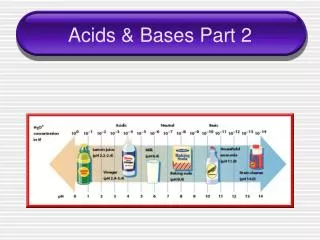
Identification • Acids have an H in front usually • Acids have a pH of less than 7 • Bases have an OH sometimes • Bases have a pH of more than 7 • Conjugate Bases of strong acids are terrible bases that have no effect on pH • Conjugate Bases of weak acids are weak bases and thus do affect pH
Identification, cont. • Conjugate acids of weak bases are weak acids and do affect pH
What it means to be a strong acid • Strong Acids dissociate completely in water • Therefore, they give up more protons than weak acids
The Six Strong Acids • HCl • HNO3 • H2SO4 • HClO4 • HI • HBr
Acid dissociation reaction in water • H2O <-> H+ + OH- • Therefore, water can act as a base or an acid
Kw • Kw = 1.0 * 10-14 • Kw / [OH-] = [H+] • Kw / [H+] = [OH-] • -log[H+] = pH • -log[OH-] = pOH • pH + pOH = 14
Writing Ka expressions • Ka = [H+][A-] / [HA] • Kb = [OH-][HB+] / [B] • Ka * Kb = Kw
Calculating pH • For strong acids: -log[H+] • For strong bases: -log[OH-] • For weak acids or bases: ICE table
Calculating pH, cont. • 1.) determine major species in solution • 2.) Decide which species in the reaction will control [H+] • 3.) Set up an ICE table for the reaction to determine [H+]
Calculating pH of buffers • Ex.) We add 0.05 mols of NaOH to a 500 mL solution of 0.25 M HOCl and 0.20 M NaOCl. Assume no volume change.
Sample problem :D • Calculate the pH of a 0.20 M solution of HF (Ka = 7.2 * 10-4)
Another Sample Problem • 20. The ionization constant for acetic acid is 1.8 × 10⁻⁵; that for hydrocyanic acid is 4 × 10⁻¹⁰. In 0.1 M solutions of sodium acetate and sodium cyanide, it is true that • (a) [H+] equals [OH–] in each solution • (b) [H+] exceeds [OH–] in each solution • (c) [H+] of the sodium acetate solution is less than that of the sodium cyanide solution • (d) [OH–] of the sodium acetate solution is less than that of the sodium cyanide solution • (e) [OH–] for the two solutions is the same
Yet another sample problem • 12. A solution prepared by mixing 10 mL of 1 M HCl and 10 mL of 1.2 M NaOH has a pH of • (a) 0 • (b) 1 • (c) 7 • (d) 13 • (e) 14