Download
1 / 35
350 likes | 477 Vues
This presentation outlines the latest studies on frictional cooling at Columbia University and Nevis Labs, led by researchers Raphael Galea and Allen Caldwell, with contributions from summer students. The talk elaborates on the mechanics of frictional cooling, simulation and optimization strategies, phase rotation techniques, and experimental findings related to muon colliders. By focusing on energy loss mechanisms and the dynamics of muon production and acceleration, this work aims to enhance muon beam performance for future particle physics experiments, including Higgs factories and neutrino studies.

E N D
Frictional Cooling Studies at Columbia University &Nevis Labs Raphael Galea Allen Caldwell Stefan Schlenstedt (DESY/Zeuthen) Halina Abramowitz (Tel Aviv University) Summer Students: Christos Georgiou Daniel Greenwald Yujin Ning Inna Shpiro Will Serber
Outline • Introduction & Motivation • Frictional Cooling • Simulation and Optimization • Taget and p capture • Phase Rotation • Cooling cell • Nevis experimental work • Results and Conclusions
Physics at a Muon Collider • Muon Collider Complex: • Proton Driver 2-16GeV; 1-4MW leading to 1022p/year • p production target & Strong Field Capture • COOLING resultant m beam • m acceleration • Storage & collisions • Stopped m physics • n physics • Higgs Factory • Higher Energy Frontier
Cooling Motivation • ms not occur naturally so produce them from p on target – p beam – decay to m • p & m beam occupy diffuse phase space • Unlike e & p beams only have limited time (tm=2.2ms) to cool and form beams • Neutrino Factory/Muon Collider Collaboration are pursuing a scheme whereby they cool ms by directing particles through a low Z absorber material in a strong focusing magnetic channel and restoring the longitudinal momentum • IONIZATION COOLING COOL ENERGIES O(200MeV) • Cooling factors of 106 are considered to be required for a Muon Collider and so far factors of 10-100 have been theoretically achieved through IONIZATION COOLING CHANNELS
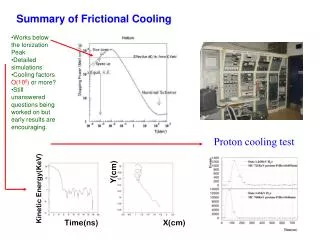
Frictional Cooling • Bring muons to a kinetic energy (T) range where dE/dx increases with T • Constant E-field applied to muons resulting in equilibrium energy
Problems/Comments: • large dE/dx @ low kinetic energy • low average density • Apply to get below the dE/dx peak • m+has the problem of Muonium formation • s(Mm) dominates over e-stripping s in all gases except He • m-has the problem of Atomic capture • s calculated up to 80 eV not measured below ~1KeV • Cool m’s extracted from gas cell T=1ms so a scheme for reacceleration must be developed
Frictional Cooling: particle trajectory • In 1tm dm=10cm*sqrt{T(eV)} • keep d small at low T • reaccelerate quickly ** Using continuous energy loss
Frictional Cooling: stop the m • High energy m’s travel a long distance to stop • High energy m’s take a long time to stop Start with low initial muon momenta
Phase rotation is E(t) field to bring as many m’s to 0 Kinetic energy as possible • Put Phase rotation into the ring Cooling scheme
Target Study Cu & W, Ep=2GeV, target 0.5cm thick
Target System • cool m+ & m- at the same time • calculated new symmetric magnet with gap for target
0.4m 28m p’s in red m’s in green View into beam
Target & Drift Optimize yield • Maximize drift length for m yield • Some p’s lost in Magnet aperture
Phase Rotation • First attempt simple form • Vary t1,t2 & Emax for maximum low energy yield
Phase Rotation Cu W
Cell Magnetic Field Correction solenoid Main Ring Solenoid Extract & accelerate • Realistic Solenoid fields in cooling ring
Fringe fields produce Uniform Bz=5T DBr=2% Uniform Bz total field
Simulations Improvements • Incorporate scattering cross sections into the cooling program • Born Approx. for T>2KeV • Classical Scattering T<2KeV • Include m- capture cross section using calculations of Cohen (Phys. Rev. A. Vol 62 022512-1)
Scattering Cross Sections • Scan impact parameter q(b) to get ds/dq from which one can get lmean free path • Use screened Coloumb Potential (Everhart et. al. Phys. Rev. 99 (1955) 1287) • Simulate all scatters q>0.05 rad
Barkas Effect • Difference in m+ & m- energy loss rates at dE/dx peak • Due to extra processes charge exchange • Barkas Effect parameterized data from Agnello et. al. (Phys. Rev. Lett. 74 (1995) 371) • Only used for the electronic part of dE/dx
Frictional Cooling: Particle Trajectory • m- use Hydrogen • Smaller Z help in scapture • Lower r fewer scatters • BUT at higher equilibrium energy • 50cm long solenoid • 10cm long cooling cells • rgas for m+ 0.7atm & m- 0.3atm • Ex=5MV/m • Bz=5T realistic field configuration
Motion in Transverse Plane • Assuming Ex=constant Lorentz angle
Emittance Calulation After cooling cylindrical coordinates are more natural After drift cartesian coordinates More natural Beamlet uniform z distribution:
X 100 beamlets Beamlet coordinates:
Problems/Things to investigate… • Extraction of ms through window in gas cell • Must be very thin to pass low energy ms • Must be gas tight and sustain pressures O(0.1-1)atm • Can we applied high electric fields in small gas cell without breakdown? • Reacceleration & recombine beamlets for injection into storage ring • The m- capture cross section depends very sensitively on kinetic energy & fall off sharply for kinetic energies greater than e- binding energy. NO DATA – simulations use calculation • Critical path item intend to make measurement
Conclusions • Frictional cooling shows promise with potential cooling factors of O(105-106) • Simulations contain realistic magnet field configurations and detailed particle tracking • Built up a lab at Nevis to test technical difficulties • There is room for improvement • Phase rotation and extraction field concepts very simple • Need to evaluate a reacceleration scheme