Understanding Mass, Weight, and Density in Scientific Inquiry
This article explores key concepts in the scientific method and physical science, focusing on mass, weight, and density. It explains the differences between mass (the amount of matter, measured in kilograms) and weight (the force of gravity acting on that mass), illustrated with examples, including how gravity affects weight on different celestial bodies. Additionally, it outlines the scientific method's systematic approach for research through steps such as forming hypotheses and conducting experiments, with practical examples demonstrating calculations of density using mass and volume.

Understanding Mass, Weight, and Density in Scientific Inquiry
E N D
Presentation Transcript
Mass vs. Weight • Matter – anything that has mass & takes up space • Mass– measurement that tell how much matter you have (kg) • Weight– measurement of the amount of matter you have with the effect of gravity
For Example… • Let’s say a guy weighs 150 pounds • This is about 54 kg in mass • What would his mass be on the moon if the moon’s gravity is about 1/6 that of the Earth?
Hmmmm… • Would it be 1/6 of 150 pounds? • Would it be 1/6 of 54 kg? • Would it be 150 pounds • Or would it be 54 kg? The answer is … 54 kg
Some of you are scratching your heads… • The reason is because gravity has NOTHING to do with mass – that’s only for weight • His mass did not change only his weight changed
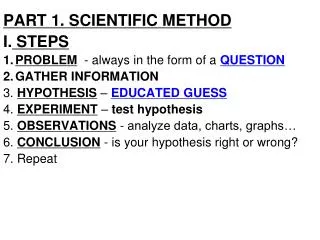
The Scientific Method • The Scientific Method– a systematic approach used in scientific study • It is an organized approach for scientists to do research • Provides a method for scientists to verify their work and the work of others
Steps for the Scientific Method Step # 1 – Research • Research – the act of gathering information (data) • Qualitative data– information with NO numbers • (hot, blue, rainy, cold) • Quantitative data– information with numbers • (98°F, 80% humidity, 0°C)
Steps for the Scientific Method Step # 2 – Form aHypothesis • Hypothesis – tentative explanation for what has been observed • There is no formal evidence at this point • It is just a guess
Steps for the Scientific Method Step # 3 – Experiment • Experiment – a set of controlled observations that test the hypothesis • Independent variable – the thing that you change in the experiment • Dependent variable – the thing that changes because you changes the independent variable • Constant – something that does not change during the experiment • Control – the standard for comparison
For example… • Let’s say we are going to do an experiment testing what happens when you heat and cool a balloon… We will start with a balloon at room temperature
Now we will change something… I will add heat to one balloon ________ What will happen to the balloon’s size?
Now let’s cool things down I will add cool down the balloon _____________ What will happen to the balloon’s size?
So what is what? • What variable did YOU change? • Temperature • What variable changes BECAUSE you changed the temperature? • Size of the balloon • What is did not change in the experiment? • Kind of balloon • What balloon did you use to compare the others to? • Didn’t change temperature (Independent Variable) (Dependent Variable) (Constant ) (Control)
Steps for the Scientific Method Step # 4 – Conclusion • Conclusion – judgment based on the information obtained
M V M D = D V Density • Density - mass per unit volume (g/cm3)
M D V Density • An object has a volume of 825 cm3 and a density of 13.6 g/cm3. Find its mass. GIVEN: V = 825 cm3 D = 13.6 g/cm3 M = ? WORK: M = DV
WORK: V = M D M D V Density A liquid has a density of 0.87 g/mL. What volume is occupied by 25 g of the liquid? GIVEN: D = 0.87 g/mL V = ? M = 25 g
WORK: D = M V M D V Density You have a sample with a mass of 620 g & a volume of 753 cm3. Find density. GIVEN: M = 620 g V = 753 cm3 D = ?
Density • The good thing about density is that it is an intrensicproperty • That means that the density of a substance is the same regardless of the amount present. • If you find the density of an unknown material, you can look it up in a density chart to find its identity
Density • I have a block that measures 5.25 cm by 2.25 cm by 8.50 cm. • I weigh the block and find its mass to be 5.85 g • Calculate the density of the block in g/cm3
What of you have an odd shaped object? • The density of an odd shaped object can be found by the same equation • D = M / V • To find the mass, you just weigh the odd shaped object • To find the volume, you place water in a graduated cylinder and get an initial volume • Then you place the object into the graduated cylinder. • The volume of the object is the difference in the two volumes
For example • A chunk of metal has a mass of 5.25 g. It is placed in a graduated cylinder containing 25.0 ml of water. Once the metal is placed in the graduated cylinder, the water rises to 38.2 ml. What is the density of the metal?