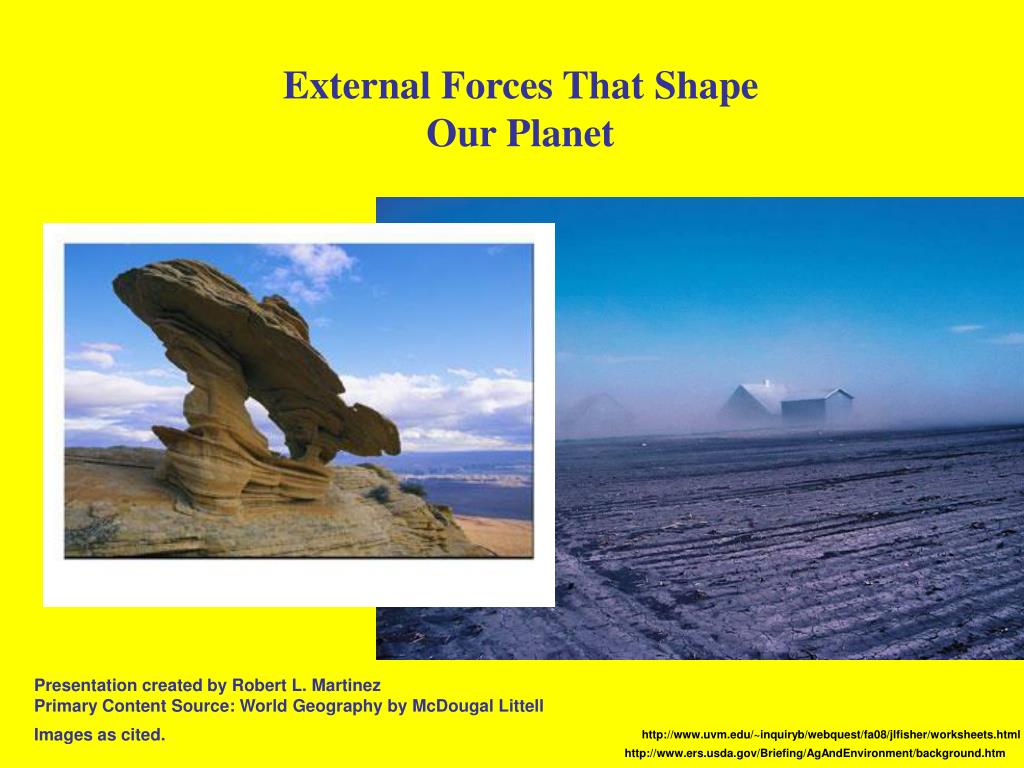
External Forces That Shape Our Planet. Presentation created by Robert L. Martinez Primary Content Source: World Geography by McDougal Littell Images as cited. http://www.uvm.edu/~inquiryb/webquest/fa08/jlfisher/worksheets.html. http://www.ers.usda.gov/Briefing/AgAndEnvironment/background.htm.
Une image / un lien ci-dessous est fourni (tel quel) pour télécharger la présentation
Politique de téléchargement : le contenu du site vous est fourni TEL QUEL pour votre information et votre usage personnel ; il ne peut être vendu, concédé sous licence ni partagé sur d’autres sites sans l’accord de son auteur.Le contenu vous est fourni TEL QUEL, pour votre information et votre usage personnel uniquement.Téléchargez la présentation en cliquant sur ce lien.Lors du téléchargement, si vous ne parvenez pas à télécharger une présentation, l’éditeur a peut-être supprimé le fichier de son serveur.Pendant le téléchargement, si vous ne parvenez pas à obtenir une présentation, le fichier a peut-être été supprimé par l’éditeur.
F I N
Plus de contenu associé
Transcription de la présentation
External Forces That ShapeOur Planet Presentation created by Robert L. Martinez Primary Content Source: World Geography by McDougal Littell Images as cited. http://www.uvm.edu/~inquiryb/webquest/fa08/jlfisher/worksheets.html http://www.ers.usda.gov/Briefing/AgAndEnvironment/background.htm
Weathering processes create smaller and smaller pieces of rock called sediment. Sediment is mostly identifiable as either mud, sand, or silt, which is very fine particles of rock. http://www.pubinfo.vcu.edu/masc/photos-2003-04/photos-2003.htm kohalacenter.org
Mechanical weathering does not change the composition of the rock, only its size and shape. For example, when ice crystals build up in the crack of a rock, they can actually create enough pressure to fracture the rock into smaller pieces. http://kayty.glogster.com/glog-8007/
Another form of erosion is abrasion, the grinding away of rock by transported particles. The heavier the load of sentiment, the greater the abrasion on the banks and riverbed. ://geology.about.com/od/geoprocesses/ig/mechweathering/abrasion
A third eroding action of water occurs when the water dissolves chemical elements in the rock. The composition of the rock changes as a result. http://pulse.pharmacy.arizona.edu/9th_grade/culture_cycles/earth_science/erosion.html
Deposits of loess, windblown silt and clay sediment that produce very fertile soil, are found across the world. In northern China, for example, the deposits are several hundred feet deep. http://www.pbase.com/dougsherman/image/93270863
Rocks caught underneath the glacier are ground into finer and finer particles. Some particles are so small that they are called rock flour, which is one component of soil. http://ana20cristina.blogspot.com/2009/03/gif-letras-numeros-y-simbolos-en-rombos_4508.html
When the ice melts, it leaves a long snakelike ridge called an esker. Sometimes blocks of ice are trapped in the sediment. They melt slowly and leave behind a dent or a depression in the ground. http://robinsonroom.blogspot.com/2010/06/glacial-features-photos.html
Water and air share tiny pore-like spaces in the soil. When it rains, the pores are filled with water. As the water evaporates, drains away, or is used by the plants, the pores are filled with air. http://www.flickr.com/photos/dirkvdw/3752985815/
Connexion au compte
Connectez-vous pour publier votre contenu sur SlideServe.