
SlideServe
Menu
Préférences
© SlideServe · v2026

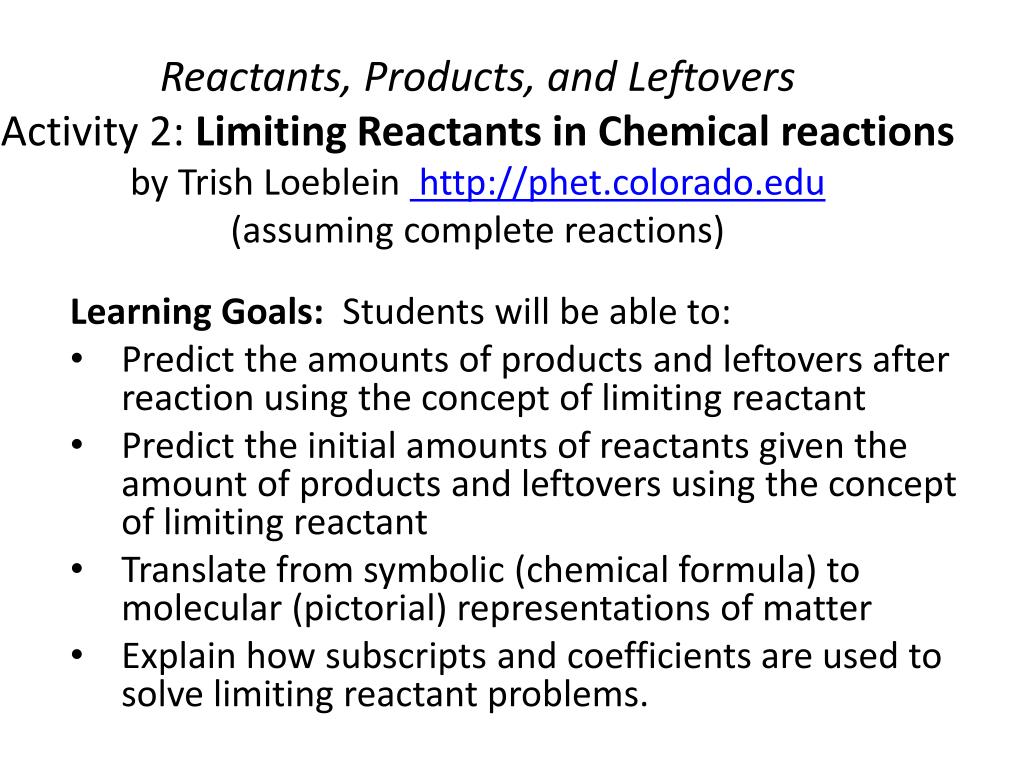
Learning Goals: Students will be able to:
karl avatar
15 diapositives · 483 Views · Jul 29, 2014

Reactants, Products, and Leftovers Activity 2: Limiting Reactants in Chemical reactions by Trish Loeblein http://phet.colorado.edu (assuming complete reactions). Learning Goals: Students will be able to:
Learning Goals: Students will be able to: - slide 1
01 / 15Learning Goals: Students will be able to:
1 / 17

Télécharger la présentation

Learning Goals: Students will be able to:
Une image / un lien ci-dessous est fourni (tel quel) pour télécharger la présentation

Politique de téléchargement : le contenu du site vous est fourni TEL QUEL pour votre information et votre usage personnel ; il ne peut être vendu, concédé sous licence ni partagé sur d’autres sites sans l’accord de son auteur.Le contenu vous est fourni TEL QUEL, pour votre information et votre usage personnel uniquement. Téléchargez la présentation en cliquant sur ce lien. Lors du téléchargement, si vous ne parvenez pas à télécharger une présentation, l’éditeur a peut-être supprimé le fichier de son serveur.Pendant le téléchargement, si vous ne parvenez pas à obtenir une présentation, le fichier a peut-être été supprimé par l’éditeur.

F I N

Plus de contenu associé

Transcription de la présentation
  1. Reactants, Products, and Leftovers Activity 2:Limiting Reactants in Chemical reactionsby Trish Loeblein http://phet.colorado.edu(assuming complete reactions) Learning Goals: Students will be able to: Predict the amounts of products and leftovers after reaction using the concept of limiting reactant Predict the initial amounts of reactants given the amount of products and leftovers using the concept of limiting reactant Translate from symbolic (chemical formula) to molecular (pictorial) representations of matter Explain how subscripts and coefficients are used to solve limiting reactant problems.

  2. 1. A mixture of 4 moles of H2 and 3 moles of O2reacts to make water. Identify: limiting reactant, excess reactant, and how much is unreacted. Limiting Excess reactantreactant • H2 1 mole H2 • H2 1 mole O2 • O2 1 mole H2 • O2 1 mole O2 • No reaction occurs since the equation does not balance with 4 mole H2 and 3 mole O2

  3. 2. A mixture of 6moles of H2 and 2moles of O2reacts to make water. How much water is made? • 6 moles water • 2 moles water • 3 moles water • 4 moles water • No reaction occurs since the equation does not balance with 6 mole H2 and 2mole O2

  4. 3. A mixture of 2.5 moles of Na and 1.8 moles of Cl2 reacts to make NaCl. Identify: limiting reactant, excess reactant, and how much is unreacted. Limiting Excess reactantreactant • Na .7 mole Na • Na .7 mole Cl2 • Na .55 mole Cl2 • Cl2 .7 mole Na • Cl2 1 mole Na

  5. 4. A mixture of 2.5 moles of Na and 1.8 moles of Cl2 reacts to make NaCl. How much sodium chloride is made? • 2.5 moles NaCl • 1.8 moles NaCl • 0.7 moles NaCl • 0.55 moles NaCl • 1 mole Nacl

  6. 5. The reaction for combustion of methane is Given the shown amounts for each reactant, predict the amounts of products and leftovers after complete reaction.

  7. 5. What are the amounts after the reaction? Initial: 7 CH4and 3 O2 • 6 1 1 2 • 1 61 2 • 1 0 6 12 • 4 0 4 8 After:

  8. 6. Given the shown amounts for the products and leftovers aftera complete reaction, predict the initial reactants.

  9. 6. What are the amounts before the reaction? After: 5 NH3 0 O2 4 NO26 H2O • 47 • 97 • 10 7 • 4 0 Before:

  10. 7. Given the shown amounts for the products and leftovers aftera complete reaction, predict the initial reactants.

  11. 7. What are the amounts before the reaction? After: 8 C2H2 4 O2 4 CO2 2 H2O • 2 10 • 12 10 • 10 9 • 8 4 Before:

  12. 8. A mixture of S atoms ( ) and O2 molecules ( ) in a closed container is represented by the diagrams: Which equation best describes this reaction? • 3X + 8Y X3Y8 • X3 + Y8 3XY2 + 2Y • X + 2Y XY2 • 3X + 8Y  3XY2 + 2Y • X3 + Y8 3XY2 + Y2 From Lancaster/Perkins activity

  13. 9. An initial mixture of sulfur( ) and oxygen( )is represented: Using this equation: 2S + 3O22SO3, what would the results look like? From Lancaster/Perkins activity

  14. 9. Before: S O2 2S + 3O22SO3 A B C D E From Lancaster/Perkins activity

  15. 10. Before: S O2 2S + 3O22SO3 Which is the limiting reactant? Sulfur Oxygen Neither they are both completely used From Lancaster/Perkins activity