Classification
This text explores the principles of taxonomy, focusing on the science of naming and classifying organisms. It discusses the binomial nomenclature system introduced by Carolus Linnaeus, detailing the significance of genus and species in scientific names. The article covers the seven levels of classification, highlighting the limitations of Linnaean classification and how molecular evidence has reshaped our understanding of evolutionary relationships. It also introduces the three domains and six kingdoms, summarizing the characteristics of each group of organisms, including Archaea, Bacteria, Protista, Plantae, Fungi, and Animalia.


Classification
E N D
Presentation Transcript
Classification By: Amber Tharpe
Taxonomy- science of naming and classifying organisms • Taxon- group of organisms in a classification system • Carolus Linnaeus- responsible for scientific naming system we use today
Binomial nomenclature- system that gives each species a 2 part scientific name using Latin words • Always underlined or written in italics • Genus- a group of physically similar species • First part of a scientific name, always capitalized • Species indicator- most specific part of scientific name • Second part of scientific name, always lowercase
Why use this complicated system? • Universal • Latin is a dead language • Some species have more than 1 common name • Ex: roly-poly aka pillbug, sowbug,and potato bug • Armadilidium vulgare
Seven Levels of Classification • Kingdom (most general) • Phylum • Class • Order • Family • Genus • Species (most specific) • King Phillip Came Over For Good Spaghetti
Look at Figure 17.3 on p. 520 • What animals are dropped as we move from kingdom to phylum? • What well-known Australian animal is excluded from the Carnivora order, which includes all true bears? • How can this be? • From what you can infer from the figure, what are the characteristics of animals in the order Carnivora?
Limitations of Linnaean Classification • Focuses on physical similarities alone • Does not account for convergent evolution • Genetic research has proved the flaws in this system
Phylogeny- evolutionary history for a group of species • Cladistics- classification based on common ancestry • Cladogram- diagram that shows an evolutionary family tree- how species are related through common ancestors • Derived characters- traits seen in some species, but not seen in others • Nodes- points where a branch splits
Molecular Evidence • Proteins and DNA are compared to determine evolutionary relationships • Molecular clocks- models that use mutation rates to measure evolutionary time
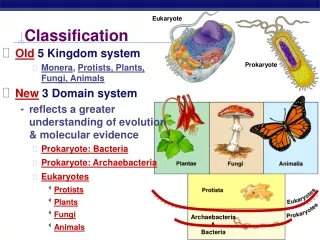
Classification • Always changing • Currently • 3 Domains • 6 Kingdoms • 3 Domains • Archaea • Bacteria • Eukarya • Made up of eukaryotic cells
Classifying Organisms Today • Determine groups by comparing: • physical structures • biochemistry (DNA and proteins) • evolutionary relationships • Still discovering many new species in • Tropical rain forests • Deep ocean
6 Kingdoms • Archaea (Archaebacteria) • Bacteria (Eubacteria) • Protista • Animalia • Plantae • Fungi
Archaea • Single-celled prokaryotes with special cell walls that allow them to live in extreme environments
Bacteria • Single-celled prokaryotes with cell walls made of peptidoglycan • Ex: bacteria and blue-green algae • Protista- microscopic organisms that lack 1 or 2 characteristics to fit in any other category • Ex: euglenas, amoebas, paramecia, and single-celled algae • Plantae- multicellular autotrophs with cell walls made of cellulose with tissue systems
Fungi- heterotrophs that absorb food from dead materials • Ex: mushroom (multicellular) and yeast (single-celled) • Cell walls made of chitin • Animalia- multicellular heterotrophic animals with organ systems • Ex: humans, cats, insects, worms, sponges, ect.