SlideServe
Menu
Préférences
© SlideServe · v2026

Dynamic Index Coding

kasa avatar
19 diapositives · 291 Views · Jul 25, 2014

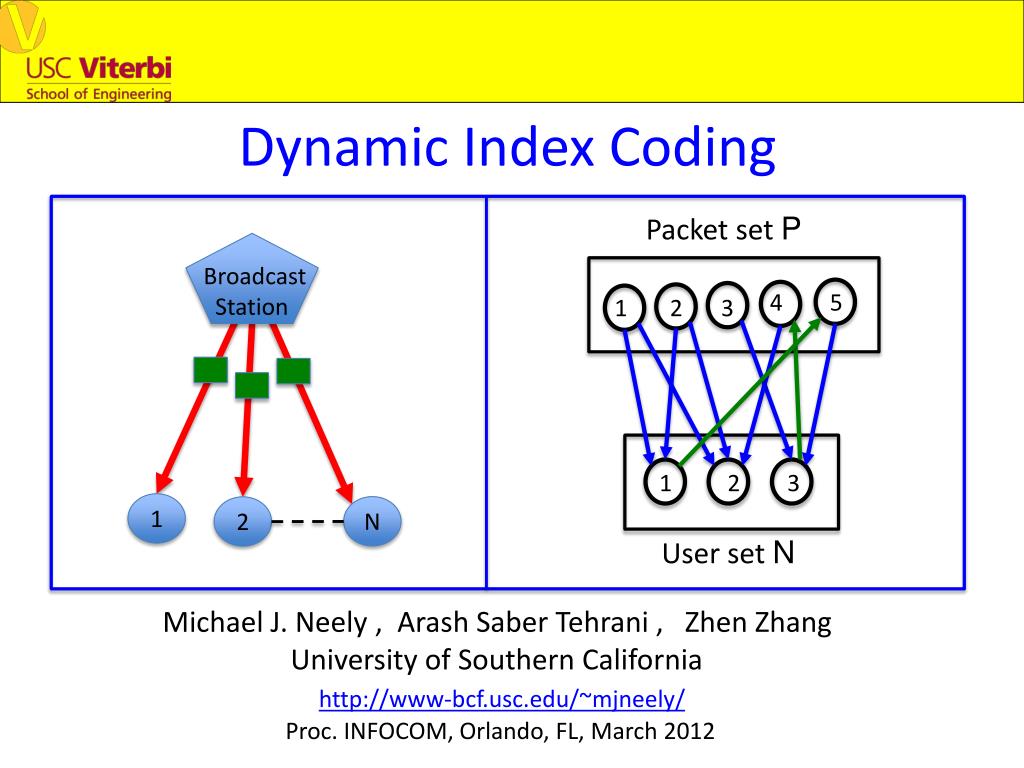
Dynamic Index Coding. 4. 5. 1. 2. 3. Packet set P. Broadcast Station. 1. 2. 3. 1. N. 2. User set N. Michael J. Neely , Arash Saber Tehrani , Zhen Zhang University of Southern California
Dynamic Index Coding - slide 1
01 / 19Dynamic Index Coding
1 / 17

Télécharger la présentation

Dynamic Index Coding
Une image / un lien ci-dessous est fourni (tel quel) pour télécharger la présentation

Politique de téléchargement : le contenu du site vous est fourni TEL QUEL pour votre information et votre usage personnel ; il ne peut être vendu, concédé sous licence ni partagé sur d’autres sites sans l’accord de son auteur.Le contenu vous est fourni TEL QUEL, pour votre information et votre usage personnel uniquement. Téléchargez la présentation en cliquant sur ce lien. Lors du téléchargement, si vous ne parvenez pas à télécharger une présentation, l’éditeur a peut-être supprimé le fichier de son serveur.Pendant le téléchargement, si vous ne parvenez pas à obtenir une présentation, le fichier a peut-être été supprimé par l’éditeur.

F I N

Plus de contenu associé

Transcription de la présentation
  1. Dynamic Index Coding 4 5 1 2 3 Packet set P Broadcast Station 1 2 3 1 N 2 User set N Michael J. Neely , Arash Saber Tehrani , Zhen Zhang University of Southern California http://www-bcf.usc.edu/~mjneely/ Proc. INFOCOM, Orlando, FL, March 2012

  2. Motivation Packet set P 4 5 1 2 3 BS • Want to expand wireless throughput. • Wireless users download popular files. • Some users already have the files in cache. • Can we push information theory and network theory to exploit this side info? User set N 1 2 3 1 N 2

  3. Simple Model Packet set P 4 5 1 2 3 BS • N users. P packets in Broadcast Station (BS). • Each user wants a different subset of packets. • Each user already has a different subset of packets in its cache. • BS can transmit 1 packet/slot. • All users successfully hear all BS transmissions. User set N 1 2 3 1 N 2

  4. Can we finish in less than P slots? BS • Example 1: Want: A Want: B Have: B Have: A User 1 User 2

  5. Can we finish in less than P slots? BS • Example 1: • Related to Wireless Net Coding: • Wu, Chou, Kung 2005 • Kattiet. Al. 2005, 2006. + A B Efficiency Ratio = 2:1 Want: A Want: B Have: B Have: A User 1 User 2

  6. Can we finish in less than P slots? BS • Example 2: Want: A Want: B Want: C Have: B C Have: A C Have: A B User 1 User 2 User 3

  7. Can we finish in less than P slots? BS • Example 2: Efficiency Ratio = 3:1 + + A B C Want: A Want: B Want: C Have: B C Have: A C Have: A B User 1 User 2 User 3

  8. K-Cycle Coding Actions User 2 Want: A Have: B Message 1: A + B Message 2: B + C Message 3: C + D User 1 Want: D Have: A User 3 Want: B Have: C Want: C Have: D User 4 • Clears K packets in K-1 slots • (efficiency ratio = K : K-1 )

  9. Minimum Clearance Time Tmin • Unsolved Info Theory Problem! • Even Restricting to Linear Codes is NP Hard! • [Birk, Kol 2006] • [Bar-Yossef, Birk, Jayram, Kol 2011] • What can we say?

  10. Information Theory Result Packet set P 4 5 1 2 3 *Theorem 1: If the bipartite demand graph is acyclic, then Tmin= P. User set N 1 2 3 *Extends [Bar-Yossef, Birk, Jayram, Kol 2011] to the case of general demand graphs.

  11. Information Theory Result Packet set P 4 5 1 2 3 *Theorem 1: If the bipartite demand graph is acyclic, then Tmin= P. User set N 1 2 3 Cor 1: Need cycles for coding to help. Cor2: Max acyclic subgraph bound. *Extends [Bar-Yossef, Birk, Jayram, Kol 2011] to the case of general demand graphs.

  12. Dynamic Index Coding • Packets arrive randomly, rates (l1, …, lM). • A = Abstract space of coding options. • example: A = {Cyclic coding actions}. • Each code action α in A has: • T(α) = frame size of action α. • (μ1(α), …, μM(α)) = clearance vector of action α. Frame 1 Frame 2 Frame 3 T(a[1]) T(a[2]) T(a[3]) time

  13. Max-Weight Code Selection Algorithm • Every new frame k, observe queues (Q1[k], …, QM[k]) • Then choose code action α[k] in A to maximize: • ∑mQm[k] [μm(α[k])/T(α[k])] Theorem 2: This alg supports any rate vector (λ1, …, λM) in the Code-Constrained Capacity region LA. (where LAis optimal region subject to using codes in set A).

  14. Simulation of Max-Weight Code Selection Max-Weight Details: 3 user system. Each user has packets arriving rate λ. Each packet is independently in cache of another user with prob ½. Total number of traffic types = M = 12.

  15. Question When does LA= L ? LA= Code constrained capacity region L= Capacity region (info theory)

  16. Special case of Broadcast Relay Networks: • Users want to send to other users via Broadcast Relay. • Each packet contained as side info in exactly one user. • Each packet has exactly one user as destination. • Admits a simplified graphical structurewith user nodes only. We can often compute Tmin.

  17. Results for N-user Broadcast Relay Nets: Algorithm: Max-Weight Code Selection with Cyclic Coding. • N=2 (Lis 2-dimensional) • N=3 (L is 6-dimensional) • Any N, provided that either: (i) Each user sends to at most one other user. (ii) Each user receives from at most one other user. This is information-theoretically optimal in these cases:

  18. Conclusions Packet set P 4 5 1 2 3 BS User set N 1 2 3 1 N 2 • Acyclic Graph Theorem. • Dynamic Index Coding Exploits Cycles. • Achieves Code Constrained Capacity Region. • Achieves Info Theory Capacity Region for Classes of Broadcast Relay Networks. • This is a new example of a consummated union between Information Theory and Networking.

  19. Special case of Broadcast Relay Networks: • Admits a simplified graphical structure, can often compute Tmin. • (nodes = users, links labeled by # packets) 7 users 48 packets Tmin = 39 Max Acyclic Subgraph Graph with 3 disjoint cycles