Download

1 / 40
400 likes | 518 Vues
This presentation by Prof. Marti Hearst at the PSU Graduate Research Symposium discusses significant trends in search user interfaces, emphasizing the shift towards more natural language interactions, the rise of spoken input technologies, and the integration of social behaviors in search. Hearst explores how advancements in audio/video/touch interactions and machine learning are shaping user preferences, leading to more intuitive designs in information retrieval. The talk also forecasts the future of dialogue-based search systems, turning traditional search paradigms into collaborative and socially enriched experiences.

E N D
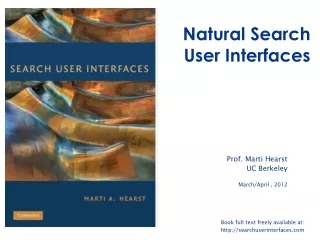
Prof. Marti Hearst UC Berkeley PSU Graduate Research Symposium March 25, 2011 Emerging TrendsinSearch User Interfaces • Book full text freely available at: • http://searchuserinterfaces.com
First: What are the larger trends? In technology? In society? Next: Project out from these. Forecasting the Future
Preferences for Audio / Video / Touch Preferences for Social Interaction Preferences for Natural Language “Natural” Interfaces Statistical Analysis of Enormous Collections Of Behavioral and Other Data Wide adoption of social media & user-generated content Advances in UI Design
Why Spoken Input? • Phone-based devices widely used • Naturally accepts spoken input • Difficult to type on • Touch screen interaction increasingly popular • Also difficult to type on • Speech recognition technology is improving • Huge volumes of training data is now available • What are the impediments?
Alternative text entry swype.com Gesture search, Li 2010
Speaking leads to conversation • Dialogue is a long-time dream of AI • We’re getting closer with a combination of • Massive behavioral data • Intense machine learning research • Advanced user interface design • Real-time contextual information
Far Future Trend: Dialogue • SIRI came out of the DARPA CALO project
People are Social; Computers are Lonely. Don’t Personalize Search, Socialize it! Trend: Social Search
Social Search Implicit: Suggestions generated as a side-effect of search activity. Explicit: knowledge accumulating via the deliberate contributions of many. Collaborative: Working with other people on a search task. Asking: Communicating directly with others.
Social Search: People Collaborating Pickens et al., SIGIR 2008
Social Search: People Collaborating Pickens et al., SIGIR 2008
Social Search: People Collaborating Jetter et al., CHI 2011
Social Search: Asking for Answers What do people ask of their social networks? Morris et al., CHI 2010
Social Search: Asking for Answers Asking experts in a social network Richardson and White, WWW 2011
Social Search: Explicit Help viaQuestion-Answering Sites • Content is produced in a manner amenable to searching for answers to questions. • Search tends to work well on these sites and on the internet leading to these sites • Like an FAQ but • with many authors, and • with the questions that the audience really wants the answers to, and • written in the language the audience wants to use.
Social Search: Implicit Suggestions • Implicit human-generated suggestions still beat purely machine-generated ones • Spelling suggestions • Query term suggestions (“search as you type”) • Recommendations (books, movies, etc) • Ranking (using clickthrough statistics)
Social Search: Explicit Rec’dations • “Crowdsourcing” for explicit recommendations • Digg, StumbleUpon • Delicious, Furl • Google’s SearchWiki (now defunct) • Open Directory • Blekko
Social Search: Seeing what people you know have seen • Yahoo MyWeb, Google Social Search
Social Search: Explicit SuggestionsBuilding Knowledge • Social knowledge management tools seem promising • Utilize the best of social networks, tagging, blogging, web page creation, wikis, and search. Millen et al., CHI 2006
Trend: Longer, more natural queries • The research suggests people prefer to state their information need rather than use keywords. • But after first using a search engine they quickly learned that full questions resulted in failure. • Average query length continues to increase • In 2010 vs 2009, searches of 5-8 words were up 10%, while 1-2 word searches were down.
Trend: Longer, more natural queries • Information worded as questions is increasing on the web. • From social question-answering sites and forums. • Maps colloquial expression into technical.
Trend: More Natural Queries • Blend two ideas: • “sloppy commands” • predictions based on user behavior data • This is subtly and steadily increasing in sophistication across many interfaces
Sloppy Commands • Like command languages, but • the user has a lot of flexibility in expression • so memorization is not required • “time graz” “what time is it in graz” “graz time now”
Sloppy Commands + Visual Feedback • Can include rich visual feedback • Quicksilver in Apple • Inky by Miller et al.
Sloppy Commands + Rich Data • Combine Mozilla’s Ubiquity and Freebase to make a flexible predictive query engine • By spencerwaterbed: http://vimeo.com/13992710
Summary • As CS gets more sophisticated, we can build search interfaces that allow people to interact more naturally: • More language-like queries • Speaking & viewing rather than typing & reading • More able to interact with other people while doing search tasks • More able to use the knowledge in peoples’ heads