Enhancing Test Coverage through White-box Testing with Whispec
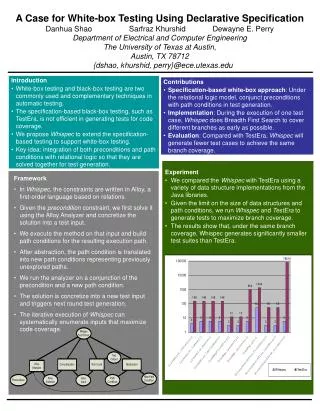
This paper presents Whispec, an innovative approach that integrates white-box testing into specification-based black-box testing. Traditional methods like TestEra struggle with code coverage efficiency. Whispec utilizes relational logic to unify preconditions and path conditions, allowing for more effective test generation. The implementation employs a Breadth-First Search technique to optimize branch coverage, generating fewer test cases while achieving the same outcomes. Evaluations show that Whispec significantly reduces test suite sizes compared to TestEra, improving efficiency in software testing processes.

Enhancing Test Coverage through White-box Testing with Whispec
E N D
Presentation Transcript
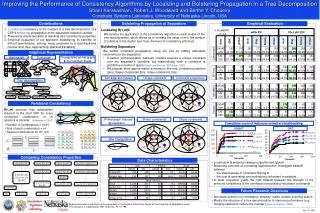
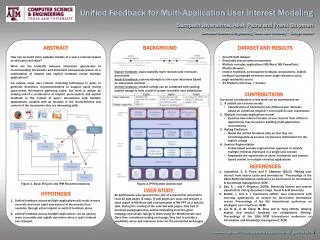
A Case for White-box Testing Using Declarative SpecificationDanhua Shao Sarfraz Khurshid Dewayne E. PerryDepartment of Electrical and Computer EngineeringThe University of Texas at Austin, Austin, TX 78712 {dshao, khurshid, perry}@ece.utexas.edu • Introduction • White-box testing and black-box testing are two commonly used and complementary techniques in automatic testing. • The specification-based black-box testing, such as TestEra, is not efficient in generating tests for code coverage. • We propose Whispec to extend the specification-based testing to support white-box testing. • Key idea: integration of both preconditions and path conditions with relational logic so that they are solved together for test generation. • Contributions • Specification-based white-box approach: Under the relational logic model, conjunct preconditions with path conditions in test generation. • Implementation: During the execution of one test case, Whispec does Breadth First Search to cover different branches as early as possible. • Evaluation: Compared with TestEra, Whispec will generate fewer test cases to achieve the same branch coverage. • Experiment • We compared the Whispec with TestEra using a variety of data structure implementations from the Java libraries. • Given the limit on the size of data structures and path conditions, we run Whispec and TestEra to generate tests to maximize branch coverage. • The results show that, under the same branch coverage, Whispec generates significantly smaller test suites than TestEra. • Framework • In Whispec, the constraints are written in Alloy, a first-order language based on relations. • Given the precondition constraint, we first solve it using the Alloy Analyzer and concretize the solution into a test input. • We execute the method on that input and build path conditions for the resulting execution path. • After abstraction, the path condition is translated into new path conditions representing previously unexplored paths. • We run the analyzer on a conjunction of the precondition and a new path condition. • The solution is concretize into a new test input and triggers next round test generation. • The iterative execution of Whispec can systematically enumerate inputs that maximize code coverage.