LWA Users Meeting
This document outlines the logistics and key information for the LWA project meeting led by Greg Taylor from UNM. It includes details about internet access, meal arrangements, and video conference setup with NRL's LWA1 status. Highlights of LWA1 operations, computing capabilities, project statuses, and deadlines for funding programs are summarized. Additionally, it discusses current staffing and ongoing research and publications related to LWA1. The document finishes with goals for the meeting, including a review of hardware, capabilities, and idea exchange among participants.

LWA Users Meeting
E N D
Presentation Transcript
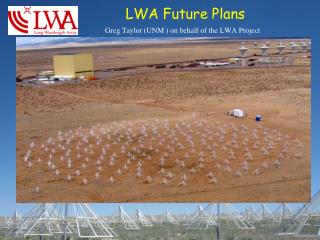
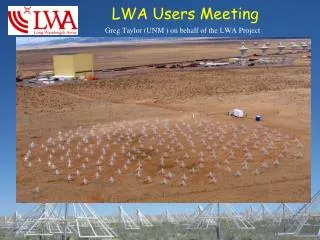
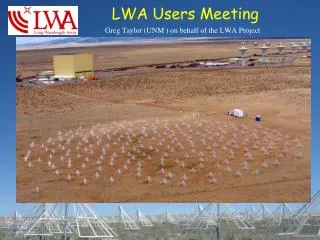
LWA Users Meeting Greg Taylor (UNM ) on behalf of the LWA Project
Meeting Logistics • Internet access: see instructions on board • Lunch – at the SUB. Please return by 1:00pm. • Dinner – at Monroe’s, 1520 Lomas Blvd, 6:15pm • NRL by video
LWA1 Status • LWA1 funded as a University Radio Observatory (from 3/1/12) • Initial Operating Capability reached on April 24, 2012 • Currently beam forming with 226 stands • All 4 beams operable, though beam 1 tends to underflow • TBN degrades during beamforming, so TBN or beams but not both • See known issues page: • http://www.phys.unm.edu/~lwa/astro/currentissues.html • User forum: • http://lwa1.freeforums.org/index.php • Looking into modifying the HVACs
HVAC icing Severe case https://lwalab.phys.unm.edu/OpScreen/os.php
Recording Capability • 37 DRSUs (27 UNM + 5 LIU and 5 VT) • mostly 10 or 15 TB capacity each • total DRSU storage 395 TB • At site typically 10 DRSUs = 376 beam hrs + 50 hrs TBW/TBN
Computing Capabilities • Hercules – dual hexacore Mac Pro with 6 TB storage • Leo – quad core with 48 TB storage • LDA – quad core with 48 TB storage at CARC • new dell dual quad core on order Leo Hercules
Current Support • ONR – extended through 9/30/2012 • LUNAR program – ends 5/1/2013 • Cosmic Dawn program (NSF) – ends 7/31/2013 • LEDA (NSF) – ends 8/30/2014 • LoFASM (UTB) – ends 1/31/2015 • URO (NSF) – ends 2/28/2015 • LWA Center at UNM (unrestricted)
LWA1 Operators • Joe Craig • Jayce Dowell • Steve Ellingson • Jake Hartman • Ken Obenberger • YlvaPihlstrom • If you want a turn let me know! • Frank Schinzel • Greg Taylor • Hank Tillman • Genevieve Vaive • Chris Wolfe
CFP1 Completion Status Code Allocated Observed Percent completed PI Project -------------------------------------------------------------------------------------------- LC001 56 89.4 160 Clarke, Jupiter LC002 344 236.5 69 Crane, Ionosphere LE001 320 2.8 0.9 Ellingson, GRB triggers LE002 640 153.39 24 Ellingson, Crab giant pulses LH001 6 14.34 239 Hartman/Schinzel, Cas A/Cyg A ratio LH002 300 429.32 143 Hartman, Hot Jupiters LK001 580 138 23.8 Kavic, mulit-messenger survey LP001 378 204 54 Pihlström, RRLs LP002 672 9 1 Polisensky, survey LR001 50 69.5 139 Ray, pulsars LS001 320 197.2 59.1 Simonetti, dispersed pulses LW001 320 41 12.8 White, solar Total number of DRX beam hrs in CFP1: 3966 Percentage completed: 40% (1585 hrs)
Programmatic Commitments Code Allocated Observed Percent completed PI Project -------------------------------------------------------------------------------------------- LB002 520 24 4.6 Bowman, Cosmic Dawn Clarke, LG001 300 0 0 Greenhill, LEDA Total number of DRX beam hrs in PC: 820 Percentage completed: 3% (24 hrs)
LWA Publications in 2012 • The LWA1 Radio Telescope, S.W. Ellingson, IEEE, 2012, submitted • First Light for the First Station of the the Long Wavelength Array, G.B. Taylor et al., JAI, 2012, in press • The Long Wavelength Array Software Library, J. Dowell et al. 2012, JAI, submitted • Probing the Climatological Impact of a Cosmic Ray-Cloud Connection through Low-Frequency Radio Observations, Magee & Kavic, 2012
Publication Policy • Opt-in policy is in effect (see publication policy!) • First author posts draft for two week “sign-up” • First author decides order of authorship • acknowledgements: “Construction of the LWA has been supported by the Office of Naval Research under Contract N00014-07-C-0147. Support for operations and continuing development of the LWA1 is provided by the National Science Foundation under grant AST-1139974 of the University Radio Observatory program."
Goals • Review LWA1 Hardware and current capabilities • Learn How to Use LWA1 • Preliminary results with LWA1 • New Instrumentation • Inform you about many related projects & proposals • Exchange ideas • Gather fodder for URO reporting
Technical Specifications: RequiredAchieved • Frequency Range: 20 MHz to 80 MHz 10 MHz to 88 MHz • Angular resolution: ≤ [8,2]” ≤ [7,1.4]” • LAS at [20,80] MHz ≥ [8,2]° ≥ [16,4]° • Baseline range: 100 m to 400 km 50 m to 600 km • Sensitivity [20,80 MHz]: ≤ [1.0,0.5] ≤ [0.5,0.1] • Collecting Area (m2) Ae= 1 x 10⁶ Ae= 4x10⁶ • Dynamic range: DR ≥ [1x103,2x103] DR≥ [2x10³, 8x10³] • max (per beam) ≥ 4 MHz = 20 MHz • min≤ 100 Hz ≤ 10 Hz • Temporal Res τ = 10 msec τ ≤ 0.1 msec • Polarization: 1 circular Full • Sky Coverage: z ≥ 40° z ≥ 15° • FoV [20,80] MHz [8,2]° ≤ [16,4]° • # of beams: 4 single pol. 4 single pol. • Configuration: 2D array, N = 53 stations 2D array, N≥53