

SlideServe
Menu
Préférences
© SlideServe · v2026

Dendrites

kathie avatar
14 diapositives · 427 Views · Jul 27, 2014

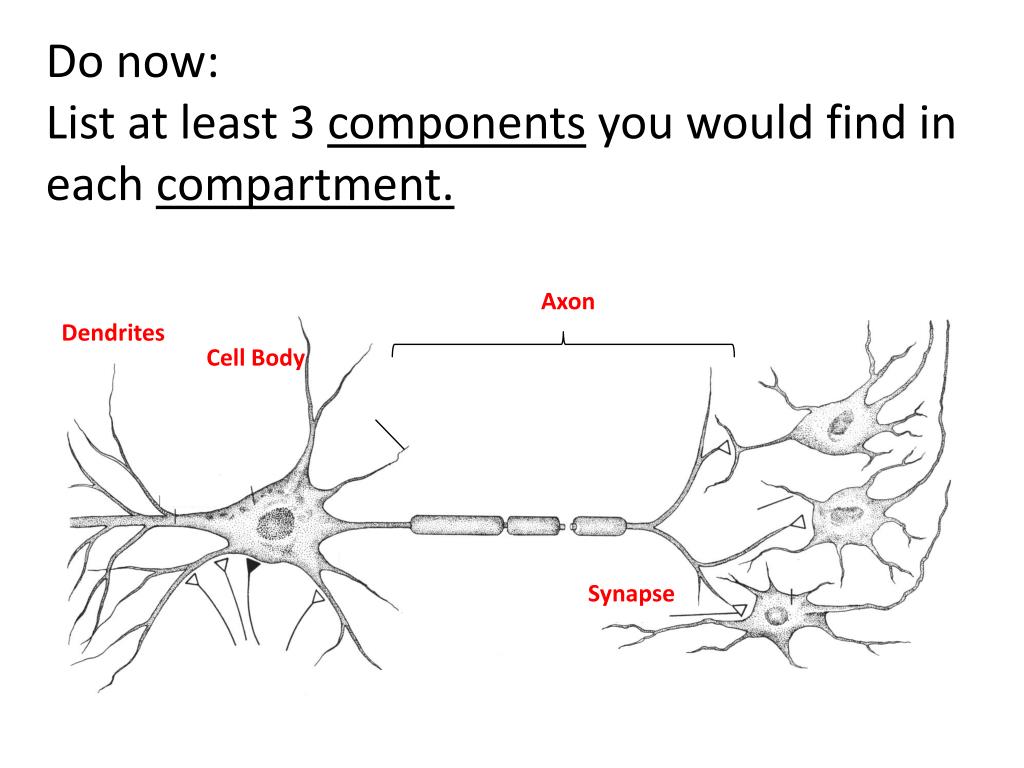
Do now: List at least 3 components you would find in e ach compartment. Axon. Dendrites. Cell Body. Synapse. Slower. Fast. Dendrites. Cell Body. Axon. Synapse. Why is transport to the synapse faster?. Moving components to the synapse and back.
Dendrites - slide 1
01 / 14Dendrites
1 / 17

Télécharger la présentation

Dendrites
Une image / un lien ci-dessous est fourni (tel quel) pour télécharger la présentation

Politique de téléchargement : le contenu du site vous est fourni TEL QUEL pour votre information et votre usage personnel ; il ne peut être vendu, concédé sous licence ni partagé sur d’autres sites sans l’accord de son auteur.Le contenu vous est fourni TEL QUEL, pour votre information et votre usage personnel uniquement. Téléchargez la présentation en cliquant sur ce lien. Lors du téléchargement, si vous ne parvenez pas à télécharger une présentation, l’éditeur a peut-être supprimé le fichier de son serveur.Pendant le téléchargement, si vous ne parvenez pas à obtenir une présentation, le fichier a peut-être été supprimé par l’éditeur.

F I N

Plus de contenu associé

Transcription de la présentation
  1. Do now: List at least 3 components you would find in each compartment. Axon Dendrites Cell Body Synapse

  2. Slower Fast Dendrites Cell Body Axon Synapse Why is transport to the synapse faster?

  3. Moving components to the synapse and back Use your worksheet to match the process with the number on the left: Vesicles are filled with neurotransmitter and then the action potential makes the vesicles release their neurotransmitter into the synapse The cell body makes hollow spheres of membrane called vesicles Vesicles that need repairing are transported back to the cell body Vesicles can be refilled with transmitter or repaired if they are damaged Vesicles are transported to the synapse on microtubule tracks. nucleus 3. 1. 1. 5. 2. 5. 4. 3. 4. 2. synapse

  4. How do we do it – and how do we do it fast enough? Vesicles are transported to the synapse on tracks made of bundles of microtubules nucleus 1. Watch video on next slide. 2. 5. Write down four things you notice about how vesicles are transported 3. 4. synapse

  5. How do we do it – and how do we do it fast enough?

  6. Write down 4 things you noticed about vesicle transport. • Transport can be in two directions. • The same vesicle can move backwards and forwards • Vesicles don’t move all the time. • When they are moving, they move at the same speed. nucleus 1. 2. 5. What hypotheses can you make about how transport works? 3. 4. synapse

  7. What hypotheses can you make about how transport works? nucleus 1. The vesicles must be motorized to allow them to move up and down. 2. 5. 3. 4. synapse

  8. What hypotheses can you make about how the motor works? Transport can be in two directions. The same vesicle can move backwards and forwards. nucleus The motors must be able to move the vesicle backwards or forwards 1. Each vesicle must be able to work with both backwards and forwards motors. 2. 5. 3. 4. synapse

  9. What hypotheses can you make about how the motor works? 3. Vesicles don’t move all the time. 4. When they are moving, they move at the same speed. Vesicles must be able to disembark from the motor or microtubules. nucleus 1. The actual time to reach the destination will be the sum of the time spent moving and the time spent stationary. 2. 5. The motors on different vesicles must be similar. 3. 4. synapse

  10. How would you figure out what the vesicles are and how they move? To ynapse Cell body 2. Moving to cell body 1. Moving to synapse

  11. Vesicle transport activity • Divide into groups of 5 or 6. • Each person in a group take a component card (blue). • Then, use the track cards (yellow) to determine which direction on the microtubules your component needs to go. • Then, select a motor cards (red) to get your component where it needs to go. Be sure that your motor selection will operate on your track selection. • Finally, use the experiment cards (green) to devise an experiment to check if you are right. • You can use as many experiment cards as you want.

  12. Wrap up • Everyone who has worked on a particular component form one group. • Compare your transport solutions – are they the same? Which is the best? Why? Come up with a consensus solution to present. • Compare your experimental strategies – are they the same? Which is best? Why? Come up with a consensus solution to present.

  13. Wrap up • Where your strategies specific enough? How did you make sure that a component destined for the axon wouldn’t end up at the synapse for example.

  14. Homework • Complete the worksheet, answering the following questions: • Research kinesins. If you want to transport a single synaptic vesicle from neuronal cell body at the base of your spine to your big toe, how much ATP will you use? • What does this tell you about axonal transport to the synapse?