Lymphatic System
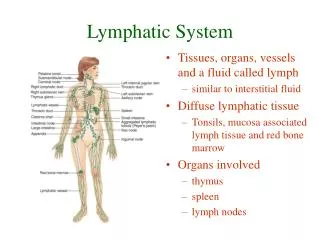
Lymphatic System. Tissues, organs, vessels and a fluid called lymph similar to interstitial fluid Diffuse lymphatic tissue Tonsils, mucosa associated lymph tissue and red bone marrow Organs involved thymus spleen lymph nodes. Functions of the Lymphatic System.

Lymphatic System
E N D
Presentation Transcript
Lymphatic System • Tissues, organs, vessels and a fluid called lymph • similar to interstitial fluid • Diffuse lymphatic tissue • Tonsils, mucosa associated lymph tissue and red bone marrow • Organs involved • thymus • spleen • lymph nodes
Functions of the Lymphatic System • Draining excess interstitial fluid & plasma proteins from tissue spaces • Transport of some nutrients and hormones • Immunity –specific defense • recognize microbes or abnormal cells & respond by killing them directly or secreting antibodies that cause their destruction
Formation & Flow of Lymph • Fluid & proteins filtered from blood capillaries are collected by lymphatic capillaries & returned to the blood • Muscle contraction and breathing promote flow of lymph • Lymphatic vessels empty into veins in shoulders
Lymph Circulation • Lymphatic capillaries • Capillaries are closed-ended tubes in tissues • One-way valves • Pickup fluid (lymph) from Tissues
Lymph Circulation • LymphaticVessels • Lymph passes from capillaries into lymph vessels • Resemble veins with thin walls & valves • Afferrent lymphatics carry lymph to nodes • Efferent lymphatics carry lymph from nodes • Lymphatic Trunks • Lymph passes from lymphatic vessels into trunks • *Bronchomediastinal, jugular, subclavian, intestinal and lumbar trunks
Lymph Circulation • Lymphatic ducts • Two ducts drain lymph from lymphatic trunks into the subclavian veins • Thoracic Duct: Larger one that drains most of body lymph into the left subclavian vein • Right Lymphatic Duct: Smaller one that drains right side of head, right shoulder and right arm into the right subclavian vein
Lymph Circulation Right Lymphatic Duct------ --------------------Thoracic Duct Right Lymphatic Duct------ Thoracic Duct----------------------------
Lymphatic Pathways Interstitial fluid Lymph Capillaries Afferent Lymphatic vessels Lymph Nodes Efferent Lymphatic vessels Lymphatic Trunks Lymphatic Ducts Subclavian Veins
Lymphocytes • B-cell lymphocytes • Respond to antigens by dividing to produce • Plasma cells: Antibody secreting cells • Memory B-cells • T-cell lymphocytes • Respond to antigens by dividing to produce • Cytotoxic T-cells that kill antigen-bearing cells • Helper T-cells that help activate other T-cells and B-cells • Memory T-cells • Natural killer (NK) lymphocytes can kill invading cells and tumor cells without need to respond to antigens – nonspecific defense
Diffuse Lymphatic Tissues • Lymphatic nodules – MALT(Mucosa Associated Lymph Tissues) • lymphatic nodules within the digestive and respiratory systems • Small intestine -Peyer's patches • Appendix • Bronchi of respiratory tract
Diffuse Lymphatic Tissues • Tonsils • Located in and around throat • Tonsilar crypts • Functions • Crypts Trap microbes • Mount immune response against inhaled and ingested microbes
Lymph organs • Lymph nodes • Structure • Location • Throughout body but concentrated in groin, neck, armpit • Functions • Filter Lymph • Mount immune response
Lymph Organs • Thymus • Located in mediastinum above heart • Large in infants atrophying with age • Function • Thymosin hormones for T-cell maturation
Spleen • Located in upper left quadrant to left of stomach • Functions • Filters blood • Produces lymphocytes • Stores iron and platelets
Defense • Non-specific Defense • First Line Defense: External • Skin • Mucous Membranes • Tears • Saliva • Stomach acid
Non-specific Defense • Second Line Defense: Internal • Antimicrobial proteins • Interferons – antiviral • Complement – immunity, allergies and inflammation • Natural killer (NK) cells • Lymphocytes • kill microbes and tumor cells • Phagocytes • Wandering phagocytes • Fixed phagocytes
Non-specific Defense • Second Line Defense: Internal • Inflammation • Mast cells and basophils release chemicals • Arterioles vasodilate – more blood to site • Increased capillary permeability – more fluid into tissues
Non-specific Defense • Inflammation results in • Redness • Heat • Swelling (edema) • Pain • Healing
Specific Defense: Immunnity • Study of immunity is immunology • Immunity versus non-specific defense • Specificity: responds to specific antigens • Memory: Second exposure to antigen causes a stronger response • Antigens • Foreign (non-self) chemicals • Cause immune response
Immunity • B-cell and T-cell lymphocytes responsible for immunity • Two types of immune responses • Cell mediated immunity: T-cells respond to intracellular antigens such as virus infected cells and tumor cells • Antibody mediated immunity: B-cells respond to extracellular antigens such as bacteria
Cell Mediated Immunity • T-cells processed by thymus gland • Two types of T-cell lymphocytes • CD4cells (Helper cells) • Activated when antigen presented by antigen presenting cell (APC) cell • Develops into helper T-cells and memory cells • Helper T-cells must stimulate CD8 cells for them to become fully activated killer T’s • CD8cells (Cytotoxic cells) • Activated by contact with virus infected body cell • Develop into killer t-cells and memory cells
Cell Mediated Immunity • Cytotoxic T’s leave lymphatic tissue to search for and destroy virus infected cells, tumor cells and tissue transplant cells on contact
Antibody Mediated Immunity • B-cell lymphocytes stay in lymph tissues • Extracellular antigen enters lymph tissue and binds to B-cell receptors • B-cells become activated • B-cells divide (clone) to form plasma cells and memory cells • Helper T-cells bind to antigen on B-cells and “help” stimulate plasma cell and memory cell formation
Antibody Mediated Immunity • Plasma cells secrete various types of antibodies • Antibodies bind to the specific antigen that activated its parent B-cells • Antibodies cause the destruction of the antigen
Antibody Mediated Immunity • Antibodies destroy antigens by • Neutralizing antigens such as toxins • Agglutinating (clumping) and precipitating (removing from solution) antigen bearing cells • Activating the complement proteins that destroy the antigen by various means • Enhancing phagocytosis
Immune Response Primary Response • After an initial exposure to an antigen a slow rise in antibodies production occur first as immunoglobulin M (IgM) then (IgG) Secondary Response • After a subsequent exposure the antibodies production is far greater and is mainly (IgG)