
FORCES
E N D
Presentation Transcript
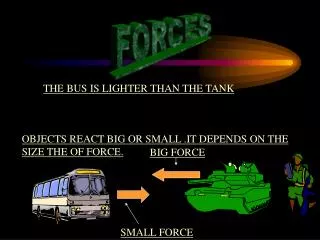
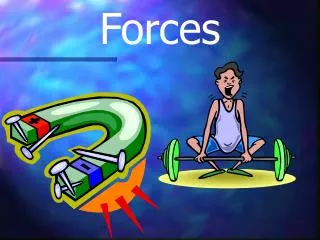
FORCES • The term force refers to the interaction of objects and their environment. • All forces are exerted on one object by another object. • Forces have both size and direction and are normally classified as “pushes or pulls”. • All forces have both size and direction
Types of Forces • Buoyancy - Is the tendency of an object to stay afloat. It is the upward force that all liquids exert on all matter (a push). • Electricity is the flow of electrons producing a current (a push). Negatively charged particles repel each other. • Friction is the force that retards the motion of two touching objects (a push).
Gravity – most familiar force • Gravity is the basic force of attraction that is spread throughout the universe. Gravity pulls objects towards each other. • Gravity on earth pulls you and all objects towards the earth. • You must overcome gravity each time you lift something. • Gravitational force on earth is 9.8m/s2
Calculating Force The relationship between an object's mass m, its acceleration a, and the applied force F Force =(mass)(acceleration) or F = ma • The SI units for force is the Newton (N) A Newton is equivalent to the units: N = kg x m s2
Example • An object with a mass of 15.0 kg is moving with an acceleration of 25.0 m/s2. What is the force acting on that object? F = ma = (15.0 kg) x (25.0m/s2) = 375 kg• m/s2 = 375 N
Another Force - Weight • Weight is a force applied to an object as a result of gravity. • Weight = mass x (gravitational force) Fw = (m) (g) • On earth, the force of gravity is nearly constant = 9.8 m/s2
Weight • It is different depending on where the object is located and the amount of gravity acting on it. • Weight is expressed in Newtons (N) • Weight of an object can be determined by the following formula Weight = (mass) (gravity) OR Fw = (m)(g)
Example If an object has a mass of 75 kg on earth, what is it’s weight? Fw = (m)(g) = (75 kg) x (9.8 m/s2) = 735 kg • m/s2 = 735 N = 740 N
How Energy Relates to Work Energy - the ability to do work Work - a measure of how productive an applied force is
Work • Work is the product of the force applied to an object time the distance through which the force acts • EXAMPLES OF WORK • Lifting a book • Pulling a cart • Pushing a door open • Sometimes there are easy ways and hard ways to do the same amount of work.
Work • The formula for work is: Work = (force) (distance) or W = Fd The unit for work is the Joule J = N * m = kg *m2 s2 It is important that you understand that all units used in the equation are in Kg, m and seconds. The problem will not be accurate (or correct) if the units are not in this form.
Example • A woman pushes a shopping cart with a force of 15.0 N a distance of 25.0m. How much work was done? • W = Fd • W = (15N) (25m) • W = 375 J = 380J
Example • A book weighing 3.0N is lifted 5.0m. How much work is done? • W = Fd • W = (3.0N) (5.0m) • W = 15J
Example • It took 45J to push a chair along the floor a distance of 7.0m. With how much force was the chair pushed? • W = Fd • You need to rearrange the equation to get force. • F = W ÷ d • F = 45J ÷ 7.0m • F = 6.4N
Example • A force of 2400N was necessary to lift a rock. A total of 450J of work was done. How far was the rock lifted? • W = Fd • Rearrange for distance • d = w ÷ F • d = 450J ÷ 2400N • d = 0.19m