
SlideServe
Menu
Préférences
© SlideServe · v2026

Ability, intelligence, IQ

katy avatar
13 diapositives · 465 Views · Sep 10, 2012

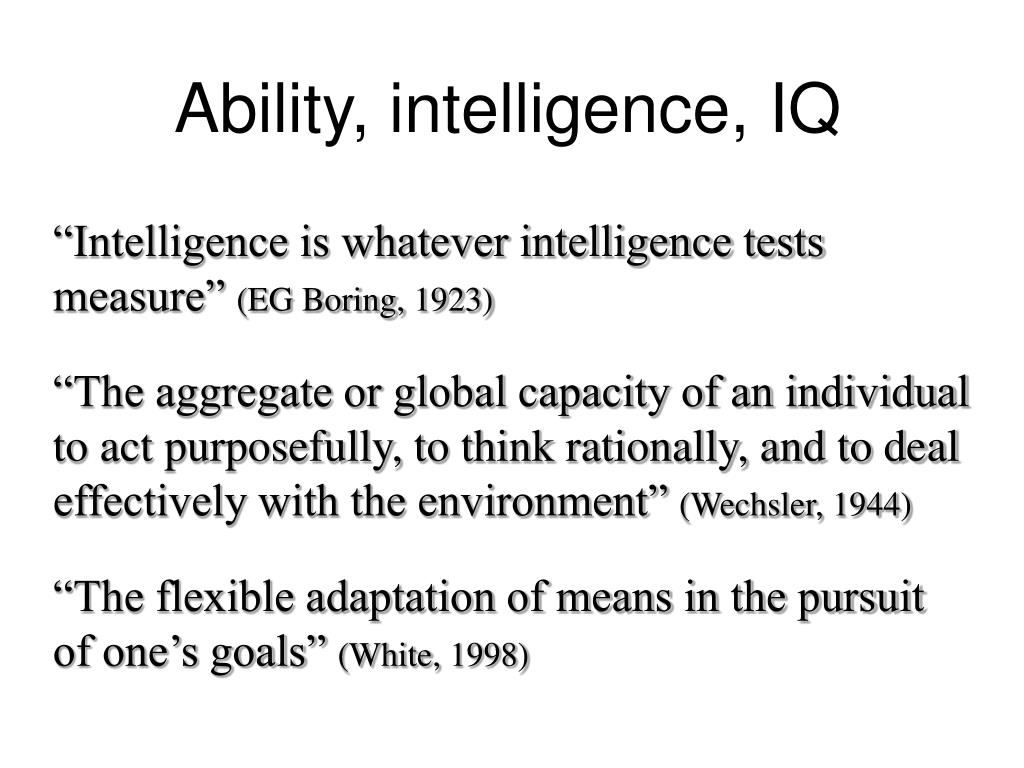
Ability, intelligence, IQ. “Intelligence is whatever intelligence tests measure” (EG Boring, 1923) “The aggregate or global capacity of an individual to act purposefully, to think rationally, and to deal effectively with the environment” (Wechsler, 1944)
Ability, intelligence, IQ - slide 1
01 / 13Ability, intelligence, IQ
1 / 17

Télécharger la présentation

Ability, intelligence, IQ
Une image / un lien ci-dessous est fourni (tel quel) pour télécharger la présentation

Politique de téléchargement : le contenu du site vous est fourni TEL QUEL pour votre information et votre usage personnel ; il ne peut être vendu, concédé sous licence ni partagé sur d’autres sites sans l’accord de son auteur.Le contenu vous est fourni TEL QUEL, pour votre information et votre usage personnel uniquement. Téléchargez la présentation en cliquant sur ce lien. Lors du téléchargement, si vous ne parvenez pas à télécharger une présentation, l’éditeur a peut-être supprimé le fichier de son serveur.Pendant le téléchargement, si vous ne parvenez pas à obtenir une présentation, le fichier a peut-être été supprimé par l’éditeur.

F I N

Plus de contenu associé

Transcription de la présentation
  1. Ability, intelligence, IQ “Intelligence is whatever intelligence tests measure” (EG Boring, 1923) “The aggregate or global capacity of an individual to act purposefully, to think rationally, and to deal effectively with the environment” (Wechsler, 1944) “The flexible adaptation of means in the pursuit of one’s goals” (White, 1998)

  2. Early childhood: 1946 (8 years) 1. Verbal comprehension Come with me to buy some (FIRE, WATER, STONE, SWEETS, MOTORS) The political dangers of monopoly seem to have been much (EXASPERATED, EXCISED, EXAGGERATED, EXPROPRIATED, EXPOSTULATED) 2. Vocabulary Cat, egg, book, apple……… celerity, extraneous, opthalmic, haemorrhage 3. Non-verbal ability i) Odd one out, ii) Sequence completion, iii) Analogy

  3. Early childhood: 1958/70 (7/5 years) • Vocabulary: • Southgate Group Reading Test (1958) • English Picture Vocabulary Test (1970) 2. Drawing a man: “Make a picture of a man or lady” 3. Copying Designs:

  4. Middle childhood: 1946/58 (11 years) Verbal ability • YARD STONE • FOOT MILE POUND ? • INCH OUNCE • __________________________________________________ • PENNY TON PINT HOUR GALLON

  5. Middle childhood: 1946/58 (11 years) Verbal ability • PUT NUT • TAP TIP TAN ? • POT NOT • ________________________________________________ • TEN TIN TUN NET NAT

  6. Middle childhood:1946/58 (11 years) Non-verbal ability ?

  7. Middle childhood: 1946/58 (11 years) Non-verbal ability ?

  8. Middle childhood: 1970 (10 years)British Ability Scales (BAS):Verbal ability 1. Word definitions (vocabulary) 2. Similarities, e.g. Orange, banana, strawberry Sad, worried, happy

  9. Middle childhood: 1970 (10 years)BAS:Non-verbal ability 1. Recall of digits (e.g. 5 4…7 5 6…8 9 5 6…2 3 7 4 6…) 2. Matrices ? ?

  10. Childhood ability tests

  11. Accumulated Cognitive CapitalMeasurement model: 46 cohort .801 g age 8 g age 11 .698 .848 .762 .977 .822 Picture Intelligence Sentence Completion Vocabulary Test Non-Verbal Intelligence Verbal Intelligence

  12. g age 11 .947 .853 Non-Verbal Intelligence Verbal Intelligence Accumulated Cognitive Capital Measurement model: 58 cohort .895 g age 7 .490 .468 .767 Southgate Group Reading Test Copy Designs Draw a Man

  13. Accumulated Cognitive Capital Measurement model: 70 cohort .787 g age 5 g age 10 .421 .781 .627 .802 .501 .634 .608 Recall of Digits Word Similarities English Picture vocabulary test Copy Designs Draw a Man Word Definitions Matrices