Innovative Road Pricing Workshop to Enhance Transportation Planning
250 likes | 348 Vues
Join the .HOV-to-HOT Lanes Workshop at the National Road Pricing Conference on June 4, 2010, led by Mark Burris from Texas Transportation Institute and Jessie Yung from Federal Highway Administration. This hands-on workshop will cover key subjects like planning, operations, design, funding, finance, and outreach, using a real freeway corridor project case study to understand challenges and best practices. Explore important concepts in transportation planning to move pricing initiatives forward in your region.


Innovative Road Pricing Workshop to Enhance Transportation Planning
E N D
Presentation Transcript
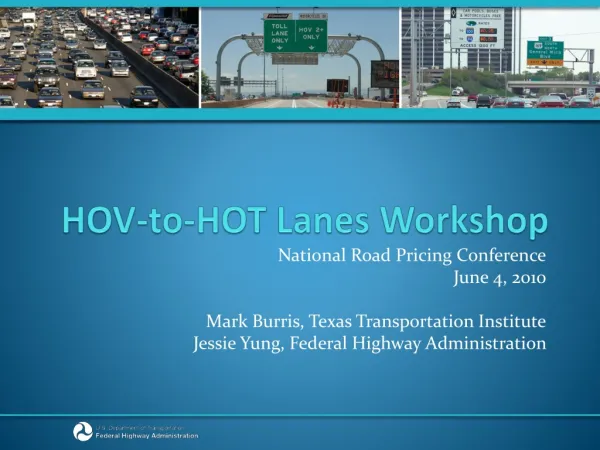
HOV-to-HOT Lanes Workshop National Road Pricing Conference June 4, 2010 Mark Burris, Texas Transportation Institute Jessie Yung, Federal Highway Administration
Workshop Purpose Provide hands-on practice in applying lessons learned and best practices from implemented projects across the country • understand the challenges in implementing pricing projects • move pricing forward in your area
Workshop Agenda • Review of Project • Break into groups for exercises • Five subject areas covered • 5-10 minute overview of subject area • 20-25 minutes to complete exercise • Break for lunch after second round of exercises • Group reports
Subject Areas • Planning • Operations • Design • Funding and Finance • Outreach • No specific order, all have overlapping elements
Our Project Radial freeway corridor serving major activity center 15 miles total length 3 GP lanes in each direction 1 HOV lane in each direction Transit service with two park-and-ride facilities Downtown rapidly developing and congestion growing No funding for expansion. Congested 4-lane adjacent radial freeway is funded for expansion Parallel arterial
Park and Ride Park and Ride Radial Freeway 8 lanes (2 HOV) Length: 15 miles 165,000 AADT Suburban Community Population 20,000 $75k median income 20% minorities 1.9 autos per household Suburban Community Population 40,000 $40k median income 40% minorities 1.3 autos per household Transit Service Peak TT: 15-20 min Peak TT: 25-30 min Competing Radial Freeway Currently 4 lanes, very congested, to be expanded to 6 lanes in the future Freeway Travel Time to Downtown GPL Peak: 20-30 min HOV Peak: 13-16 min Freeway Travel Time to Downtown GPL Peak: 12-16 min HOV Peak: 7-10 min 8 miles Competing Arterial Length: 20 miles Peak TT: 25-45 min Downtown Employment Total Travelshed Population: 200,000 $50k median income 30% minorities 1.5 autos per household
Project Characteristics • Corridor History • Congestion worsening • Downtown businesses seeking alternatives to bring more commuters downtown • Opposition to capacity improvements on adjacent radial corridor from environmental interests • Corridor demographics • Varies by sub-area • Total travelshed population = 200,000 • $50,000 median income • 30% minorities • 1.5 autos per household
Project Characteristics General Purpose Lanes • 6 lanes with full shoulders • 165,000 AADT and growing
Project Characteristics • HOV Project History • Operating for 9 years • Construction funding came from state and federal sources • Full-time HOV2+ operation (24/7) • Peak period average vehicle occupancy of 2.21 • Public perception of underutilization, 1000 vph in peak • Park-and-ride utilization at 65% , 2 lots
Project Characteristics HOV lanes • 2 lanes, one in each direction • Buffer separated • Peak volumes 800-1000 vehicles per hour • Peak period speed 65 mph
Project Characteristics Project Partners • State DOT • Owner of lanes and ROW • Operator of freeway • Transit authority • Operator of express bus service and park-and-ride facilities • Regional toll authority • Operates one toll road in region • Cash and transponder-based electronic tolling • State police • HOV enforcement • Metropolitan Planning Organization
Project Characteristics • Legal authority • HOT allowed by state statute • Regional policies • Conversion of HOV lane to HOT lane in long range plan • No policies on toll rate setting, occupancy, etc. • Environmental clearance – FONSI expected
Project Characteristics • Cross section • Access • In addition to termini, two intermediate access points to HOV lane • Between the two P&R lots • Between P&R lot and downtown • Enforcement • Enforcement areas (14’ shoulder) located on downstream ends of intermediate access points
Project Characteristics • Estimated project costs • Capital costs: $10,000,000 • Annual operating costs $1,000,000 • Available funding • State is committed to contributing $8,000,000 • FHWA/FTA program requirements and limitations – FTA funds used in construction of HOV lanes • Traffic and revenue studies – none
Planning • Establish goals and objectives and clearly communicate a vision • Take advantage of opportunities • Maintain flexibility • Engage project partners and encourage agency cooperation
Operations • Develop a Concept of Operations to guide the process • Determine vehicle occupancy based on current operating conditions • Pricing strategy • Tolling policy • Enforcement • Hours of operation • Operating parameters/goals
Design • Depends on design of HOV lanes and available room in the corridor to make modifications • Separation mechanism • Access locations • Toll collection locations • Coherent signing program • Wider buffer when using pylons or paint • Safe merging/weaving distances • Incident detection and use of ITS • Number of lanes
Design Group Exercise Develop an action plan that identifies critical design issues that need to be addressed to support a successful project. Identify user groups and design criteria based on the group requiring the greatest • flexibility (buses?). Identify and establish fundamental design parameters of facility. What are the costs involved in adopting the different separation mechanisms and the • width of the separation? Design Exercise
Funding and Finance • Ownership for facility and right-of-way • Available assistance through federal programs • Stakeholders • Revenue sharing
Outreach • Identify project champions • Conduct market research and identify issues • Develop clear and concise messages • Communicate project goals • Outreach to travelers about changes in access or other conditions • Continue from project development through operations • Create brand awareness