Download
1 / 12
150 likes | 300 Vues
Homophones are words pronounced the same but differ in spelling and meaning. This guide explores their characteristics and significance in language learning. It includes strategies to teach homophones to students, emphasizing the importance of context for understanding their usage. Through examples and riddles, educators can engage students in recognizing and differentiating homophones, thereby enhancing their reading fluency and spelling skills. This resource aims to provide effective techniques to incorporate homophones into teaching methodologies.

E N D
HomophonesVocabulary Hilary Allbritton Maya Austin, Natalie Bennett,
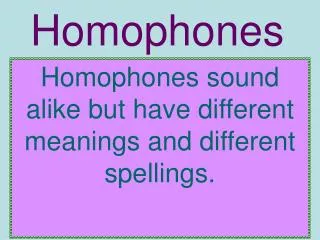
What is a Homophone? • Words are spelled differently and have different meanings • Have you ever heard of a group of words called homophones? • Homophones are words that are pronounced the same but have different spelling and meaning
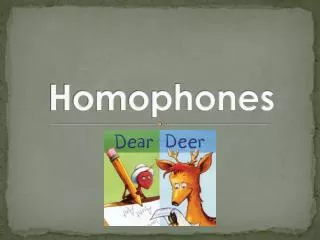
Homophones • It is helpful to look at context clues in sentences that have homophones to know what homophones is being used. • 1. My mom bought me a pair of shoes. • 2. Brad ate a pear for snack today. • Was there anything else in the sentence that helped you to know the difference between pear and pair?
How you Should Teach Homophones • Homophones are more of a problem for spelling than reading because context usually clarifies their meaning. • Although, in some cases, it is important to recognize the spelling of certain words in order to interpret the meaning of a sentence correctly. • A great way of introducing homophones to your students is to discuss riddles. • Write a riddle on the dry erase board and have students identify the word that is a homophone. • For example, “What is black and white and read all over?” (the newspaper)-read is the homophone
Purpose of Homophones • The purpose is to develop reading fluency by recognizing that sometimes words are pronounced the same but have different spellings or meanings.
Procedure for Implementing Homophones • Steps: • 1. Read the selection • 2. Write the sentence that contains the homophone. • 3. Circle the homophone. • 4. Write the meaning of the homophone beside the word.