SlideServe
Menu
Préférences
© SlideServe · v2026

Chapter 19: Electrochemistry

kedma avatar
11 diapositives · 436 Views · Aug 09, 2014

Chapter 19: Electrochemistry. Lecture Topics 1. Balancing Redox /Oxidation-Reduction Reactions. 2. Voltaic Cells 3. Electrolysis 4. Corrosion. Chapter 19: Oxidation Reduction Reactions. (1) Oxidation: Loss e- Increase in Oxidation Number Zn (s) Zn 2+ + 2e -

Chapter 19: Electrochemistry - slide 1
01 / 11Chapter 19: Electrochemistry
1 / 17

Télécharger la présentation

Chapter 19: Electrochemistry
Une image / un lien ci-dessous est fourni (tel quel) pour télécharger la présentation

Politique de téléchargement : le contenu du site vous est fourni TEL QUEL pour votre information et votre usage personnel ; il ne peut être vendu, concédé sous licence ni partagé sur d’autres sites sans l’accord de son auteur.Le contenu vous est fourni TEL QUEL, pour votre information et votre usage personnel uniquement. Téléchargez la présentation en cliquant sur ce lien. Lors du téléchargement, si vous ne parvenez pas à télécharger une présentation, l’éditeur a peut-être supprimé le fichier de son serveur.Pendant le téléchargement, si vous ne parvenez pas à obtenir une présentation, le fichier a peut-être été supprimé par l’éditeur.

F I N

Plus de contenu associé

Transcription de la présentation
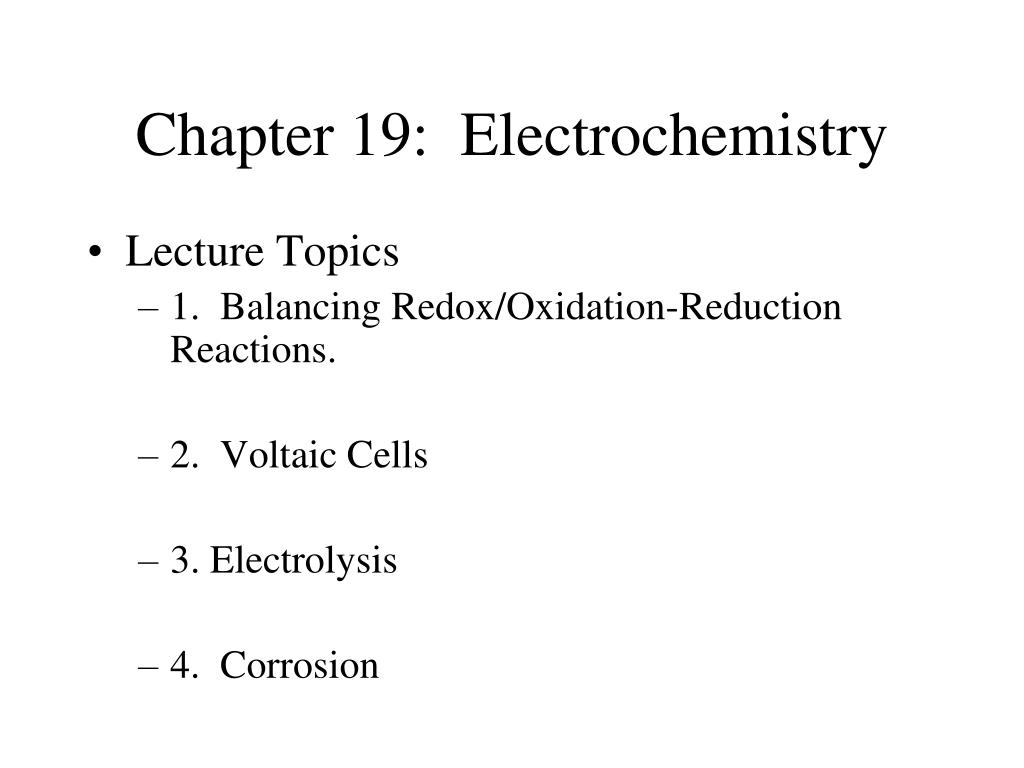
  1. Chapter 19: Electrochemistry • Lecture Topics • 1. Balancing Redox/Oxidation-Reduction Reactions. • 2. Voltaic Cells • 3. Electrolysis • 4. Corrosion

  2. Chapter 19: Oxidation Reduction Reactions • (1) Oxidation: Loss e- • Increase in Oxidation Number • Zn(s)Zn2+ + 2e- • (2) Reduction: Acceptance of e- • Decrease in Oxidation Number • Cl2(g) + 2e- 2Cl-

  3. Balancing Oxidation-Reduction Equations: Use Half-Reaction Method • The half-reactions for • Sn2+(aq) + 2Fe3+(aq)  Sn4+(aq) + 2Fe3+(aq) • are • Sn2+(aq)  Sn4+(aq) +2e- • 2Fe3+(aq) + 2e- 2Fe2+(aq) • Oxidation Half-Reaction: electrons are products. • Reduction Half-Reaction: electrons are reactants.

  4. Half-Reaction Method for Balancing Oxidation-Reduction Equations • 1. Separate the equation into the two half-reactions. Write down the two half reactions. • 2. Balance each half reaction: a. First balance all elements other than H and O. b. Then balance O by adding water. c. Then balance H by adding H+ if have acidic solution. d. Finish by balancing charge by adding electrons.

  5. Half-Reaction Method for Balancing Oxidation-Reduction Equations • 3. Multiply each half reaction to make the number of electrons equal. 4. Add the two half-reactions and simplify. To simplify, remove components common to both reactant and product sides. 5. Check!

  6. Example • Balance: (acidic) • MnO4- (aq) + C2O42- (aq)  Mn2+ (aq) + 2CO2 (g) • The two incomplete half reactions are • MnO4-(aq)  Mn2+(aq) • C2O42-(aq)  2CO2(g)

  7. Problem • Complete and balance the following equations, and identify the oxidizing and reducing agents • (a) Cr2O72- (aq) + I-(aq) Cr3+(aq) + IO3-(aq) • (acidic solution)

  8. Balancing Oxidation-Reduction Reactions: Basic Medium • When the reaction occurs in an alkaline solution, follow the rule listed below to balance H. • 1. Balance O with H2O. Then balance H with H+. • 2. Must neutralize H+. Use coefficient in front or H+, and add equivalent/same number of OH- to both sides of the half-reaction. • 3. For the side with both H+ and OH-, write H2O. • 4. Resume regular steps for balancing the half-reaction.

  9. Problem • Complete and balance the following half reaction(s) In each case, indicate whether oxidation or reduction occurs. • (d) OH- O2(g) • (basic solution) • (e) SO32-(aq) SO42-(aq) • (basic solution)

  10. Problem • Complete and balance the following equations, and identify the oxidizing and reducing agents. Pb(OH)42- (aq) + ClO- (aq) PbO2(s) + Cl-(aq) • (basic solution)

  11. Problem 19.2-B: Use the Half Reaction Method • (in a basic solution) Bi(OH)3 + SnO2 2- SnO32- + Bi