Download
1 / 8
80 likes | 180 Vues
Mexico has a vibrant but small radio astronomy community with approximately 130 astronomers spread across seven centers, including the Centro de Radioastronomía y Astrofísica at UNAM. Two significant projects, the Expanded Very Large Array (EVLA) and the Atacama Large Millimeter Array (ALMA), highlight Mexico’s strategic investment in radio astronomy. Despite challenges in contractor participation and funding from external sources, Mexican researchers aim to enhance their role in the global scientific community, with potential future engagement in the Square Kilometre Array (SKA) through innovative projects and collaborations.

E N D
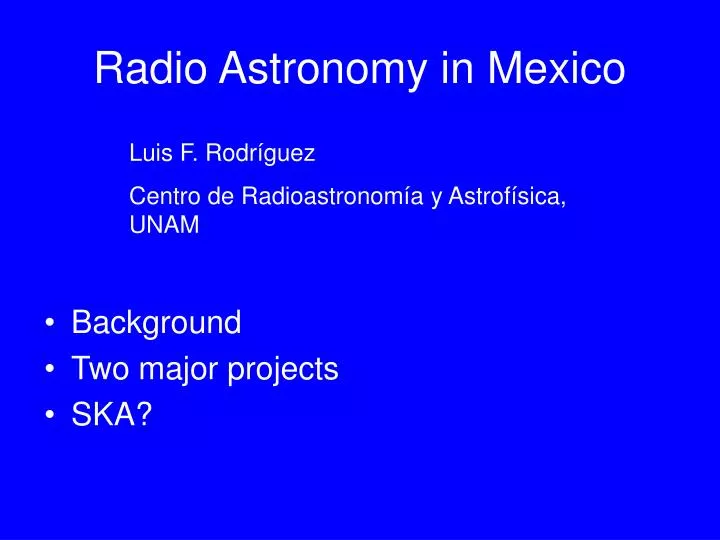
Radio Astronomy in Mexico • Background • Two major projects • SKA? Luis F. Rodríguez Centro de Radioastronomía y Astrofísica, UNAM
Who/Where we are… • ~130 astronomers at ~7 research centers • ~14 radio astronomers at ~4 research centers • ~2 PhD students per year in radio astronomy
Two Major Projects EVLA - Expanded Very Large Array + ALMA – Atacama Large Millimeter Array Centro de Radioastronomía y Astrofísica, UNAM LMT - The Large Millimeter Telescope Instituto Nacional de Astrofísica, Optica y Electrónica
EVLA and ALMA • 2 million US$ “mega” project • CONACyT funding, L.F. Rodríguez the P.I. • Despite extensive efforts, no Mexican contractors found; funding won by NRAO • Assures competitive Mexican access to ALMA
The Large Millimeter Telescope Largest Mexican science/technology project ever attempted INAOE-UMASS collaboration ~ 80 million US$ spent ~ 20 million US$ still needed
Large Millimeter Telescope Testing to start in 2007 Many challenges still in the future
Implications for SKA participation • Mexico has a small but active (and growing) radio community with a definite interest in SKA. • Short term prospects for formal participation are complex (rest of science community wants to see results from ELVA+ALMA and from LMT). • Medium and long term prospects are good, most possibly through a one-time financial contribution.
Previous Experience Indicates That… • It is highly desirable that funding is spent within Mexico. • Technical innovation and development as a Mexican contribution is quite challenging. A lot of work and organization are needed. Infrastructure is relatively strong. • One-time financial contributions are more viable than long-term commitments.