Cold War Notes
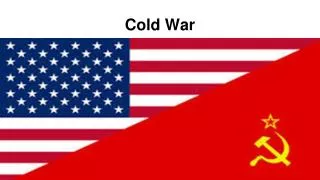
The Cold War marked a period of intense rivalry between the US and USSR following World War II. With Germany divided into democratic West and communist East, global tensions escalated. The USA relied on diplomatic strategies like the Containment Theory, the Truman Doctrine, and NATO to counteract communist influence. Key events such as the Berlin Airlift and the Korean War highlighted the high stakes of this ideological battle without direct military confrontation. Leaders like Stalin, Truman, and Mao Tse Tung influenced this complex geopolitical landscape.

Cold War Notes
E N D
Presentation Transcript
Cold War Notes How to fight a war without actually fighting the war -or- The war of words
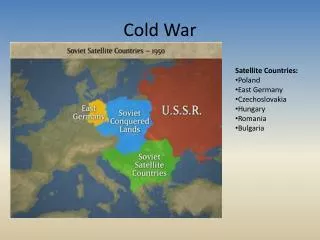
WWII Ends • Germany gets divided into 4 sections (Yalta) • Democratic – West Germany • Communist – East Germany • West Berlin – Democratic • East Berlin – Communist • Soviet Union sets up buffer zones in Eastern Europe • Berlin Airlift (1948 – 1949) • Soviets blockade supplies to West Berlin • USA airlifts supplies for 1 year until Stalin lifts blockade • 1949 Germany is officially divided
Behind the Cold War • Fighting of Diplomacy (no weapons • Tensions between US and USSR escalate • Cold War Started after Bolshevik Revolution • Theory was communism spread • USA citizens begin to worry
What to do with the Soviets • Containment Theory – George Kennan • GK never believed US and USSR would go to war • He wanted to contain or block the Soviets and stop communism from spreading • Communism would either mellow or eventually break up • Nazi Germans put up the Berlin Wall
Examples of Containment • Marshall Plan – aiding Western Europe against communism • CIA – financed the Christian Democrats in Italy in an election to defeat the Communists • Truman Doctrine – Giving aid to Greece and Turkey to fight Communism • NATO – military alliance formed against the Soviets by John Foster Dulles • SEATO • CENTO • ANZUS • Warsaw Pact – Formed by the Soviets to counteract these organizations
Why not bomb the Soviets into the stone age? • WWII soldiers were not willing to fight and wanted to go home • US would have to occupy the largest nation in the world • US would have lost an land battle with the Soviets (e.g. Napoleon, Kaiser Wilhelm, Hitler) • A-Bombs would not have stopped them because of the largeness of their nation
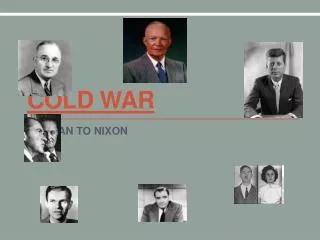
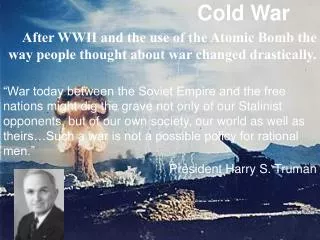
Major Players of the Cold War • Josef Stalin – Soviet dictator • Marshal Tito – Leader of Communist Yugoslavia • Truman – US president when cold war escalated • Eisenhower – US president whose foreign policy was based on containment • Mao Tse Tung - Communist China leader • Nikita Khrushchev – Soviet leader who proclaimed “Peaceful Coexistence” with the west • Fidel Castro – Cuban communist dictator • JFK – US president during Cuban Missile Crisis
Korean War – Communism tries to spread (first hot war of the cold war) • 1943 – Cairo Conference – Korean would remain free and independent • Chaing Kai-Shek (China) • Winston Churchill (Great Britain) • FDR (USA) • After WWII • North of 38 parallel - Communist • South of 38 parallel - Democratic
Korean War Continued • 1949 national election • South – democratic • North – communist • Wanted unity but under their own form of government
Korean War Continued • June 1950 – NK marches across the 38th parallel • U.N. security council votes to assist SK • Bulk of troops came from US • Only wanted to contain communism • Did not take any territory
Events of the Korean War • Macarthur gets fired • Wanted to advance on China • Wanted to completely destroy communism • Gets canned by Truman for violating containment • War ends in a stalemate • Objective of containment successful
Truce Terms • 38th parallel divides North Korea and South Korea • U.N. Troops have to evacuate islands off of NK
Results • US and USSR had negative feelings escalated • NK communist – poor and backwards • SK democratic – booming economy • First time international team fought in another nation’s war