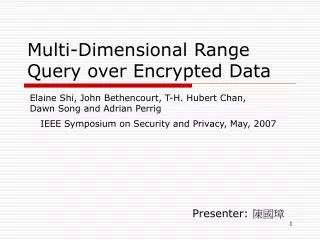
Multi-Dimensional Range Query over Encrypted Data
This presentation by Michael Chen discusses advanced methods for multi-dimensional range queries over encrypted data, aimed at enhancing data security in network audit logs and data centers. The proposed encryption scheme allows auditors to perform queries without revealing sensitive information. Key aspects covered include encryption efficiency, security challenges, and the development of a robust query mechanism. The insights are drawn from collaborative research work with Elaine Shi and others, and address real-world implications for network security.

Multi-Dimensional Range Query over Encrypted Data
E N D
Presentation Transcript
Multi-Dimensional Range Query over Encrypted Data Authors: Elaine Shi, Joint work with John Bethencourt, Hubert Chan, Dawn Song, Adrian Perrig Slides originated from Elaine Shi, modified by Michael Chen CSC 774 Advanced Network Security Instructor: Dr. Peng Ning Presenter: Michael Chen April 19, 2007
Motivation - Network Audit Logs Network gateway Data center
An Ideal Solution Network gateway Data center
Auditor Query: (100 · port · 200) Æ ( ip 2 128.1.*.*) Trusted authority auditor
Auditor Query: (100 · port · 200) Æ ( ip 2 128.1.*.*) Capability: (100 · port · 200) Æ ( ip 2 128.1.*.*) Trusted authority auditor
Security Query: (100·port ·200) Æ (ip 2128.1.*.*) • Can decrypt all matching entries • Cannot learn additional information for non-matching entries • Except for the fact that they do not match
The Challenges • Current practices: • No encryption • All-or-nothing decryption • Challenge: • How to design such an encryption scheme • Efficiency • Security
Related work • Search on encrypted data (SoE) • Not clear if can be extended to range query over multiple attributes. • Anonymous hierarchical IBE (AHIBE) • Could be used to implement MRQED, encryption cost O(TD) • Concurrent work • BonehWaters06: Complex query over encrypted data. More expensive public key size, encryption cost, cheaper decryption cost and shorter decryption key size.
Generalized Problem Definition • Time-stamp t, source address a, destination port p • A tuple (t, a, p) can be viewed as a point x in 3 dimensional space. • Query for flows with • Hyper-rectangle B in space • x is in B ?
Generalized Problem Definition • KeyGen • Key generation • Encrypt • Encryption • DeriveKey • Compute a decryption key • QueryDecrypt • Attempt to decrypt using a capability
KeyGen (, n) • Input • k: security parameter • n: bit-length of x • Output • public key PK & master private key SK KeyGen(, n) Trusted authority
Encrypt(PK, x, msg) x – a point Cipher_Text à Encrypt(PK, x, msg)
DeriveKey(PK, SK, B ) DKB t1 B – “hyper-rectangle” t2 r1 r2
QueryDecrypt(PK, DK, C) • Output • msg if • if
Roadmap • Trivial construction • AIBE – MRQED1 • Efficient representation for ranges • 1 dimensional scheme • Extension to multiple dimensions
Trivial Construction • 1 dimensionOne public key pair for each possible range - O(T2) public key pairs - O(T2) cipher texts and decryption keys for each range Performance of D dimensions T: # different values along each dimension D: # dimensions
Roadmap • Trivial construction • AIBE – MRQED1 • Efficient representation for ranges • 1 dimensional scheme • Extension to multiple dimensions
AIBE – MRQED1 • Try to decrease storage and computation cost • Efficient representation of range: - Define Interval Tree tr(T) as a binary tree over [1, T], each node represents a range - ith leaf node: cv(ID) = i - non-leaf node: cv(ID) = cv(ID1) U cv(ID2) in which ID1 & ID2 are its children nodes
AIBE – MRQED1– cont’d • Set of IDs covering a point x - if , ID covers x if . - Define P(x) to be the set such IDs. - P(x) includes all nodes on the path from leaf x to root. • Range as a collection of IDs - Define (s, t) to be the minimum set of nodes that cover range [s, t].
AIBE – MRQED1– cont’d [0, 7] [0, 3] [4, 7] [0, 1] [2, 3] [4, 5] [6, 7] 0 1 2 3 4 5 6 7 [1, 7]
AIBE – MRQED1: Encrypt C0=Encrypt(PK, IDA, msg) A C1=Encrypt(PK, IDB, msg) B C2 C3 0 1 2 3 4 5 6 7
AIBE – MRQED1: Encrypt C0 O(logT) ciphertext size C1 C2 C3 0 1 2 3 4 5 6 7
AIBE – MRQED1: DeriveKey 0 1 2 3 4 5 6 7 [2, 6]
AIBE – MRQED1: DeriveKey [2, 3] [4, 5] [6, 6] 0 1 2 3 4 5 6 7 [2, 6]
AIBE – MRQED1: DeriveKey SK SK SK 0 1 2 3 4 5 6 7 [2, 6]
AIBE – MRQED1: DeriveKey O(logT) decryption key size SK SK SK 0 1 2 3 4 5 6 7 [2, 6]
Observations: • If x 2 [s, t], then | P(x)Å(s, t) | = 1 • If x2[s, t], P(x) Å(s, t)=; AIBE – MRQED1: QueryDecrypt
AIBE – MRQED1: Decrypt C0 C1 C2 C3 0 1 2 3 4 5 6 7
AIBE – MRQED1: Decrypt C0 C1 SK SK C2 SK C3 0 1 2 3 4 5 6 7 [2, 6]
AIBE – MRQED1: Decrypt C0 C1 C2 C3 0 1 2 3 4 5 6 7
AIBE – MRQED1: Decrypt C0 C1 SKB C2 C3 0 1 2 3 4 5 6 7 [0, 3]
AIBE – MRQED1: Decrypt C0 C1 SKB C2 C3 0 1 2 3 4 5 6 7 [4, 7]
AIBE – MRQED1: Performance T: # different values along each dimension D: # dimensions
AIBE – MRQEDD – Encryption D = 2 dimensional example To encrypt point x = (3,5)
AIBE – MRQEDD – DeriveKey Query range: [2,6] x [7,3] 1st dimension: (2, 6) 2nd dimension: (3,7)
AIBE – MRQEDD Performance • O(1) PK size • O(D¢logT) • Encryption cost • Cipher Text. size • Decryption key size • O((logT)D) decrypt. cost • Good performance, but has a serious vulnerability – prone to collusion attack
Collusion Attack SKy2 R3 R4 {SKx1, SKy2} {SKx2, SKy2} SKy1 R1 R2 {SKx1, SKy1} {SKx2, SKy1} Kx1 Kx2 How fix the problem but preserve the AIBE – MRQEDD efficiency?
Collusion Attack solution - “Binding” x ¢y = c SKy2 {SKx2, SKy2} SKy1 {SKx1, SKy1} {SKx1, SKy1} SKx1 SKx2
Collusion Attack solution - “Binding” x ¢y = c SKy2 {SKx2, SKy2} x 4SKx1 SKy1 {SKx1, SKy1} {SKx1, SKy1} SKx1 SKx2
Collusion Attack solution - “Binding” x ¢y = c SKy2 {SKx2, SKy2} xSKx1 SKy1 {SKx1, SKy1} {SKx1, SKy1} SKx1 SKx2
Collusion Attack solution - “Binding” x ¢y = c SKy2 {SKx2, SKy2} xSKx1 ySKy1 SKy1 {SKx1, SKy1} {SKx1, SKy1} SKx1 SKx2
Collusion Attack solution - “Binding” x ¢y= c SKy2 {SKx2, SKy2} {SKx2, SKy2} xSKx2 ySKy2 SKy1 {SKx1, SKy1} SKx1 SKx2
The “Binding” Construction • Use Bilinear Groups • Rely on well-known difficult problem: • Decision BDH Assumption • Decision linear Assumption • Algebraically intensive
Conclusion T: # different values along each dimension D: # dimensions
Future work • Further exploration of ways to decrease the decryption co • Possible other privacy-preserving applications in addition to network audit logs, financial audit logs, etc.
Observations: • If x 2 [s, t], then | P(x)Å(s, t) | = 1 • If x2[s, t], P(x) Å(s, t)=; Question Why is this always true?