Discovery of Nano-Rivers in Superconductors: Insights from Atomic-Scale Microscopy
Researchers at Cornell University have uncovered the movement of electricity in a new class of iron-based superconductors using the world's most sensitive atomic-scale microscope. These materials, which ideally conduct electricity without loss, traditionally function only at very low temperatures. The study reveals that electricity flows not along the expected diagonal atomic stripes, but instead forms surprising horizontal “nano-rivers” of 8 iron atoms long. This breakthrough offers potential pathways for developing better superconductors, with enhanced performance for energy applications.

Discovery of Nano-Rivers in Superconductors: Insights from Atomic-Scale Microscopy
E N D
Presentation Transcript
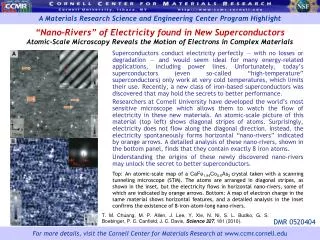
“Nano-Rivers” of Electricity found in New SuperconductorsAtomic-Scale Microscopy Reveals the Motion of Electrons in Complex Materials A Superconductors conduct electricity perfectly — with no losses or degradation — and would seem ideal for many energy-related applications, including power lines. Unfortunately, today’s superconductors (even so-called “high-temperature” superconductors) only work at very cold temperatures, which limits their use. Recently, a new class of iron-based superconductors was discovered that may hold the secrets to better performance. Researchers at Cornell University have developed the world’s most sensitive microscope which allows them to watch the flow of electricity in these new materials. An atomic-scale picture of this material (top left) shows diagonal stripes of atoms. Surprisingly, electricity does not flow along the diagonal direction. Instead, the electricity spontaneously forms horizontal “nano-rivers” indicated by orange arrows. A detailed analysis of these nano-rivers, shown in the bottom panel, finds that they contain exactly 8 iron atoms. Understanding the origins of these newly discovered nano-rivers may unlock the secret to better superconductors. Top: An atomic-scale map of aCaFe1.94Co0.6As2crystal taken with a scanning tunneling microscope (STM). The atoms are arranged in diagonal stripes, as shown in the inset, but the electricity flows in horizontal nano-rivers, some of which are indicated by orange arrows. Bottom: A map of electron charge in the same material shows horizontal features, and a detailed analysis in the inset confirms the existence of 8-iron-atom-long nano-rivers. T. M. Chuang, M. P. Allen, J. Lee, Y. Xie, N. Ni, S. L. Budko, G. S. Boebinger, P. C. Canfield, J. C. Davis, Science 327, 181 (2010). DMR 0520404 For more details, visit the Cornell Center for Materials Research at www.ccmr.cornell.edu