Download
1 / 1
20 likes | 152 Vues
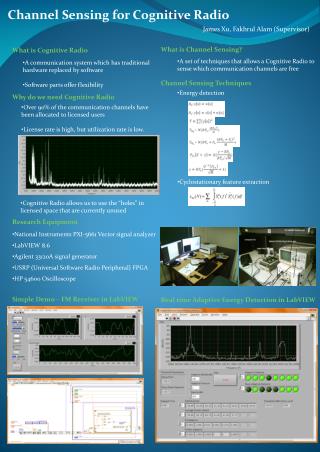
Channel sensing is a crucial technique for cognitive radio systems, enabling them to identify and utilize available communication channels. Unlike traditional systems, which rely on fixed hardware, cognitive radios leverage software for flexibility in channel management. With over 90% of communication channels already allocated to licensed users, yet underutilized, cognitive radio offers a solution by detecting unused "holes" in licensed frequencies. This presentation showcases various channel sensing techniques, including energy detection, cyclostationary feature extraction, and demonstrates using advanced research equipment like the NI PXI-5661 and USRP.

E N D
Channel Sensing for Cognitive Radio James Xu, FakhrulAlam (Supervisor) What is Channel Sensing? What is Cognitive Radio • A set of techniques that allows a Cognitive Radio to sense which communication channels are free • A communication system which has traditional hardware replaced by software • Software parts offer flexibility Channel Sensing Techniques • Energy detection Why do we need Cognitive Radio • Over 90% of the communication channels have been allocated to licensed users • License rate is high, but utilization rate is low. • Cyclostationary feature extraction • Cognitive Radio allows us to use the “holes” in licensed space that are currently unused Research Equipment • National Instruments PXI-5661 Vector signal analyzer • LabVIEW 8.6 • Agilent 33120A signal generator • USRP (Universal Software Radio Peripheral) FPGA • HP 54600 Oscilloscope Simple Demo – FM Receiver in LabVIEW Real time Adaptive Energy Detection in LabVIEW