SlideServe
Menu
Préférences
© SlideServe · v2026

Seasonal Variations in Malodorant Fluxes from Swine Waste Lagoon: Impact of Meteorological Factors

kenaz avatar
1 diapositives · 128 Views · Sep 15, 2014

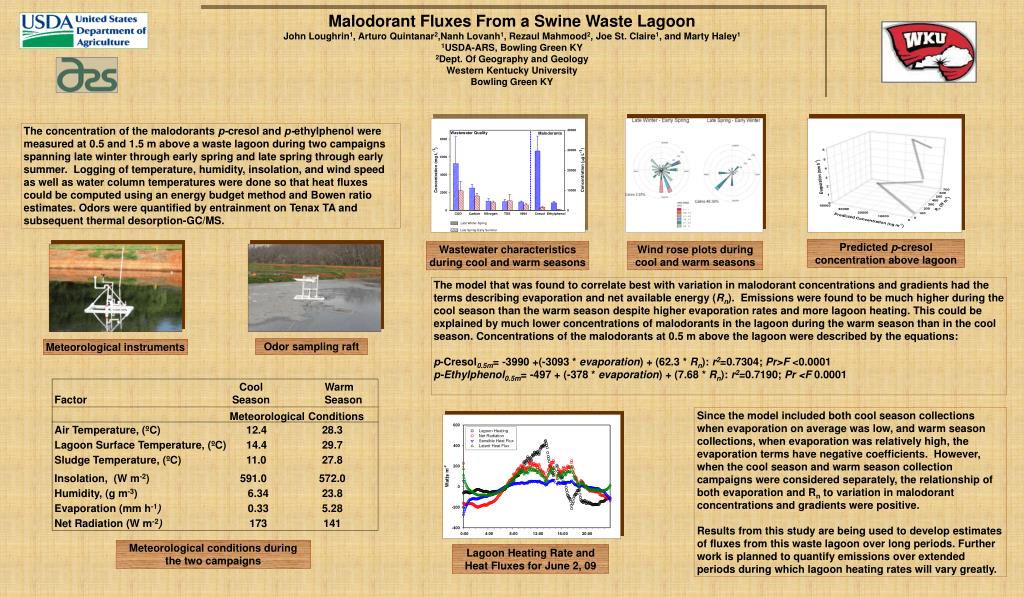
This study investigates the seasonal variations in malodorant emissions from a swine waste lagoon, analyzing factors influencing p-cresol and p-ethylphenol concentrations during cool and warm seasons. We measured lagoon surface, sludge temperatures, humidity, insolation, and evaporation rates while employing an energy budget method to compute heat fluxes. Results indicated that despite higher evaporation in warm seasons, malodorant concentrations were significantly lower than during the cool season. Our findings aim to improve estimations of odor emissions and provide insights for effective waste management practices.
Seasonal Variations in Malodorant Fluxes from Swine Waste Lagoon: Impact of Meteorological Factors - slide 1
01 / 1Seasonal Variations in Malodorant Fluxes from Swine Waste Lagoon: Impact of Meteorological Factors
1 / 17

Télécharger la présentation

Seasonal Variations in Malodorant Fluxes from Swine Waste Lagoon: Impact of Meteorological Factors
Une image / un lien ci-dessous est fourni (tel quel) pour télécharger la présentation

Politique de téléchargement : le contenu du site vous est fourni TEL QUEL pour votre information et votre usage personnel ; il ne peut être vendu, concédé sous licence ni partagé sur d’autres sites sans l’accord de son auteur.Le contenu vous est fourni TEL QUEL, pour votre information et votre usage personnel uniquement. Téléchargez la présentation en cliquant sur ce lien. Lors du téléchargement, si vous ne parvenez pas à télécharger une présentation, l’éditeur a peut-être supprimé le fichier de son serveur.Pendant le téléchargement, si vous ne parvenez pas à obtenir une présentation, le fichier a peut-être été supprimé par l’éditeur.

F I N

Plus de contenu associé

Transcription de la présentation
  1. Factor Cool Season Warm Season MeteorologicalConditions Air Temperature, (ºC) 12.4 28.3 Lagoon Surface Temperature, (ºC) 14.4 29.7 Sludge Temperature, (ºC) 11.0 27.8 Insolation, (W m-2) 591.0 572.0 Humidity, (g m-3) 6.34 23.8 Evaporation (mm h-1) 0.33 5.28 Net Radiation (W m-2) 173 141 Malodorant Fluxes From a Swine Waste Lagoon John Loughrin1, Arturo Quintanar2,Nanh Lovanh1, Rezaul Mahmood2, Joe St. Claire1, and Marty Haley1 1USDA-ARS, Bowling Green KY 2Dept. Of Geography and Geology Western Kentucky University Bowling Green KY The concentration of the malodorants p-cresol and p-ethylphenol were measured at 0.5 and 1.5 m above a waste lagoon during two campaigns spanning late winter through early spring and late spring through early summer. Logging of temperature, humidity, insolation, and wind speed as well as water column temperatures were done so that heat fluxes could be computed using an energy budget method and Bowen ratio estimates. Odors were quantified by entrainment on Tenax TA and subsequent thermal desorption-GC/MS. Predicted p-cresol concentration above lagoon Wind rose plots during cool and warm seasons Wastewater characteristics during cool and warm seasons The model that was found to correlate best with variation in malodorant concentrations and gradients had the terms describing evaporation and net available energy (Rn). Emissions were found to be much higher during the cool season than the warm season despite higher evaporation rates and more lagoon heating. This could be explained by much lower concentrations of malodorants in the lagoon during the warm season than in the cool season. Concentrations of the malodorants at 0.5 m above the lagoon were described by the equations: p-Cresol0.5m= -3990 +(-3093 * evaporation) + (62.3 * Rn): r2=0.7304; Pr>F <0.0001 p-Ethylphenol0.5m= -497 + (-378 * evaporation) + (7.68 * Rn): r2=0.7190; Pr <F 0.0001 Odor sampling raft Meteorological instruments Since the model included both cool season collections when evaporation on average was low, and warm season collections, when evaporation was relatively high, the evaporation terms have negative coefficients. However, when the cool season and warm season collection campaigns were considered separately, the relationship of both evaporation and Rn to variation in malodorant concentrations and gradients were positive. Results from this study are being used to develop estimates of fluxes from this waste lagoon over long periods. Further work is planned to quantify emissions over extended periods during which lagoon heating rates will vary greatly. Meteorological conditions during the two campaigns Lagoon Heating Rate and Heat Fluxes for June 2, 09