Download
1 / 8
80 likes | 200 Vues
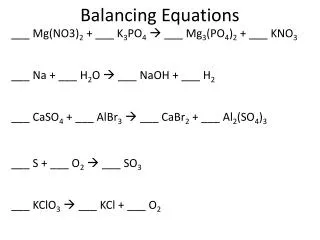
Balancing chemical equations involves adjusting the ratios of reactant and product molecules to ensure the same number and type of atoms are present on both sides. This process does not allow changes to the molecular formulas. Begin by identifying all present atoms and adjusting coefficients to balance them gradually. Practice with examples like HCl + Ba(OH)2 → BaCl2 + H2O and CH4 + O2 → H2O + CO2 to develop your skills. Balancing may require trial and error, but persistence will lead to mastery.

E N D
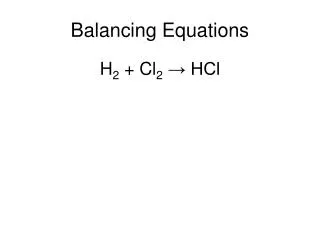
What is balancing an equation? • Balancing an equation is changing the ratios of molecules/atoms to make the lowest possible same whole number and type of atoms on each side of the equation. • Na + Cl2 NaCl 2 2
What you can not do! • You can NOT change the formula of the molecules I give you. • H2 + O2 H2O • you cannot change water to H2O2 (hydrogen peroxide) If the number is one, you don’t have to write it! 2 2 and this will make 2 water molecules you have to increase the amount of H on this side H H O O H O H H H O H H
What you are allowed to do • change the coefficient in front of any molecule/atom (changing the ratio of atoms) • ___ Ag + ___ Cl2 ___ AgCl • you can only write on those lines 2 2
Problem solving strategies • It helps to make a list of all atoms present • HCl + Ba(OH)2 BaCl2 + H2O 2 2 Ba – 1 H – 2 Cl – 2 O – 1 Ba – 1 H – 3 Cl – 1 O – 2 Start making the numbers agree one at a time (pick something, that occurs in only one molecule 1st) ~not H in this case Now going to O 4 2 4 2 Now everything is balanced! starting w/ Cl
Another to try 2 • CH4 + O2 H2O + CO2 • C- 1 C- 1 • H- 4 H- 2 • O- 2 O- 3 2 4 4 4 Everything is balanced now! This takes a lot of trial and error. Start with H now O
More Practice 2 • NH4ClO3 + CaSO4 • Ca(ClO3)2 + (NH4)2SO4
Homework • HNO3 + Zn H2 + ZnNO3