Forces
This section explores Newton's First and Second Laws of Motion, emphasizing the concept of inertia. According to Newton's First Law, an object in motion will stay in motion, and an object at rest will remain at rest unless acted upon by an outside force, illustrating principles with relatable examples like clothes on the floor and a tennis ball in motion. The Second Law introduces the formula F=MA, explaining how force equals mass times acceleration, using units of Newtons, kilograms, and meters per second squared to quantify movement.

Forces
E N D
Presentation Transcript
Forces Chapter 2, Section 3 Newton’s First and Second Laws
The First Law of Motion • Newton’s First Law of Motion – an object in motion stays in motion, an object at rest stays at rest unless acted on by an outside force. • If an object is not moving, it will not move until it is acted on by an unbalanced (outside) force. • Clothes on the floor of your room.
If an object is moving, it will continue to move until acted on by an unbalanced (outside) force. • Tennis ball flying through the air • Gravity and Friction are often the unbalanced forces that change an object’s motion.
Inertia • Inertia – the tendency to resist a change in motion. • Newton’s first law describes inertia • When driving in a car, why do you move forward in your seat when you come to a quick stop? • The greater the mass, the greater the inertia • Semi truck vs. chair
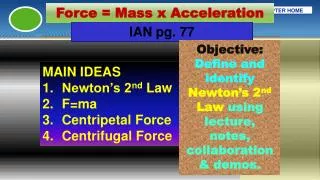
Newton’s Second Law of Motion • Newton’s Second Law of Motion – The force of an object equals the mass of the object times the acceleration of an object (F=MA). • F = Newtons (N) • Mass = kilograms (kg) • Acceleration = meters per square second (m/s2)