
Literary Devices and Terms in English 8
E N D
Presentation Transcript
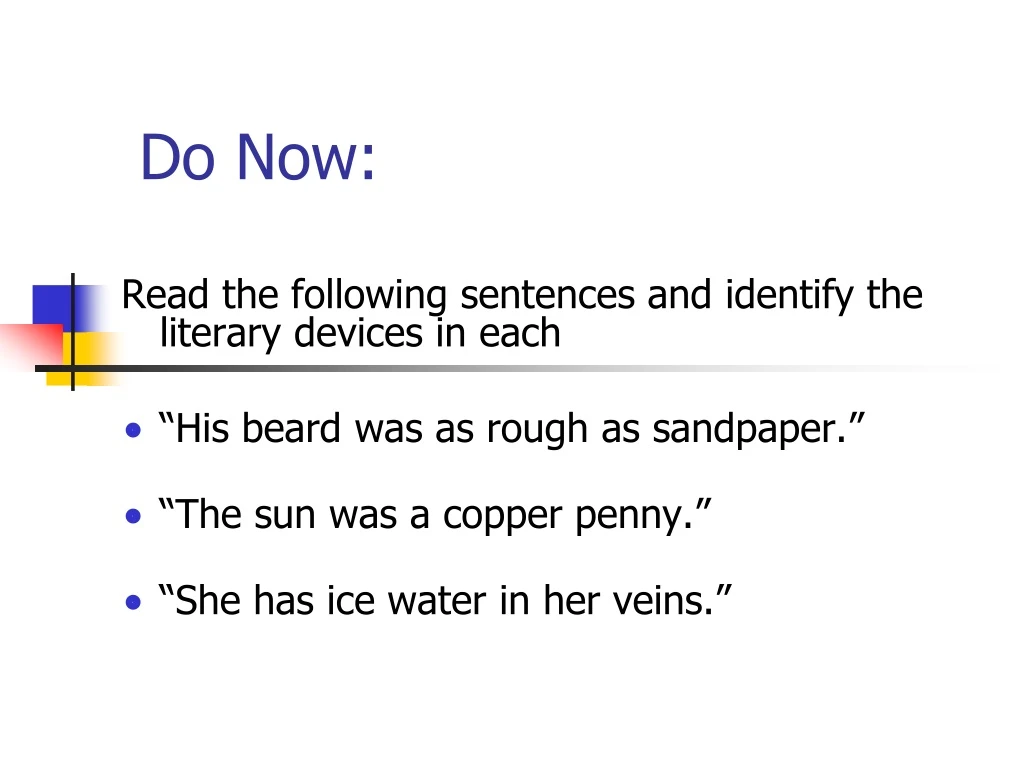
Do Now: Read the following sentences and identify the literary devices in each “His beard was as rough as sandpaper.” “The sun was a copper penny.” “She has ice water in her veins.”
Literary Terms English 8 Ms. Musynske September 2012
Atmosphere • The general mood or feeling established in a piece of literature. Examples: gloomy, peaceful, tense
Characterization • The methods used to present the personality of a character in a story. • Direct-writer tells what the character is like • Indirect-writer shows what a character is like by describing what the character looks like, says or does, or what other characters say about him/her
Characters are created by: • Giving a physical description of the character • Showing the character’s actions and letting the characters speak.
Revealing the characters thoughts • Revealing what others think of the character • Commenting directly on the character
Conflict • The struggle between two opposing forces.
Types of Conflicts: • Man vs. Man • Example • Man Vs. Nature Example • Man Vs. Self Example
**Remember that conflict may be either internal or external.
Dialogue • Talk or Conversation between two or more characters.
Flashback • An interruption of the action in a story to tell about something that happened earlier in time.
Foreshadowing • The use of hints or clues in a story to suggest future action.
Irony • A contrast between what is stated and what is really meant or between what is expected to happen and what actually happened.
Types of Irony: • Verbal irony • Situational irony • Dramatic irony (in a play the audience knows something the actors do not)
Plot • The sequence of events in a story. • Parts of a plot • Inciting incident-event that gives rise to conflict (opening situation) • Development-events that occur as result of central conflict (rising action) • Climax-highest point or suspense or interest of the story • Resolution-when conflict ends • Denouement-when characters go back to their life before the conflict
Point of View • The vantage point from which a story is told.
Types of point of view: • Third person point of view ( **most common) 1) all knowing 2) limited – tells us only what one character feels.
First person point of view ( “I”)
Setting • The time and place in which a story takes place.
Tall Tale • A highly improbable, humorous story.
Theme • The main idea expressed in a story.
Symbol • A symbol is anything that stands for or represents something else.
Tone • The attitude the writer takes toward his subject. For example: comic, serious
Characters • Types of characters • Major • Characters that are vital to the development and resolution of the conflict • Minor • Compliment the major characters and help the plot events move forward
Types of Character Cont’d • Round • Complex in temperament and motivation; capable of growth and change during the course of the narrative • Flat • Built around a single idea or quality and unchanging over the course of the narrative
Types of Characters Cont’d • Static • Referring to a character who doesn’t change over the course of a story • Dynamic • Opposite of static characters; dynamic characters undergo a change in the course of the story