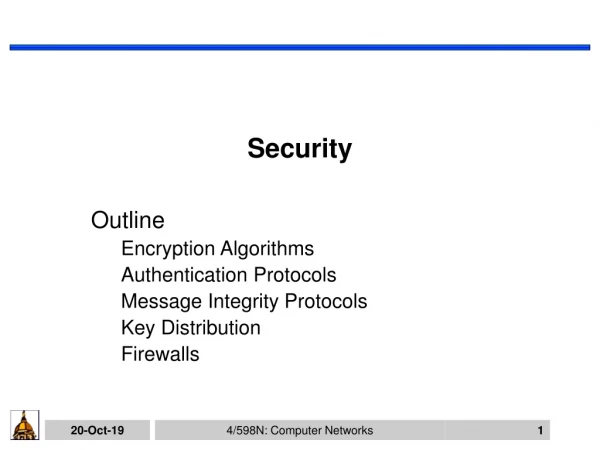
Security
This comprehensive overview of security concepts emphasizes the importance of controlling access to shared resources and ensuring that only authorized users are granted access. Explore various security techniques, including access control lists, encryption methods, and the principles of cryptography. Learn about live examples of security technologies, the value of design principles like KISS, and the challenges of protecting sensitive information. The guide also covers server-mediated authentication and the role of X.509 certificates in establishing secure communications.


Security
E N D
Presentation Transcript
Security March 9, 2001
Security • What is security? • Techniques that control access to use a shared resource • Uses of shared resource must be authorized • Authorized - who, what when, why • IRS agent authorized to access a tax evader’s files, but what about agent’s neighbor’s files? • Controlling access is a negative goal • Hard to prove that no unauthorized access occurred
Security, cont. • Examples of Security Techniques • Tickets • Access Control Lists • Encryption (e.g., PGP) • EM shielding • Pad Locks • Independent certifications • Obscurity
Security, cont. • Security Is Very Difficult • Suppose every email message out of your computer is intercepted and read by a human • Can you nevertheless send out the contents of a 1 Gig file undetected, using email? • Yes, lots of ways • Use metadata to hide 1 Gig file • Much slower, but effective Time value of data varies
Security, cont. • Design Principles • KISS - Keep It Small and Simple • Fail-safe defaults (e.g., permission, not exclusion) • Complete, systematic, and holistic approach • Open design • Explicit assumptions • Least authority • Human acceptability • Immediate feedback
Security, cont. • Example: Virtual Memory • Distinct pages for data • Virtual page number must be in page map • Distinct memory spaces for processes • Hardware - page map address register points to a process's page map • Kernel/User bit • Authorizes access to page map address register • Can be set only to Kernel by user program and vice versa
Security, cont. • Protecting Information - No Guarantees • Not practical to try to fully protect some information • e.g., Medical records from doctors, IRS data from IRS agents • To better protect, use authentication and log who did what, when, and why • Allow interested parties to audit the log
Security, cont. • Protecting Information - Cryptography • Idea - Reversibly transform plaintext into seemingly random cipertext • Plaintext - the original text • Ciphertext - the encrypted text • 6 main categories of attack: • Ciphertext-only, known plaintext, chosen plaintext, adaptive chosen plaintext, chosen ciphertext, adaptive ciphertext
Security, cont. • Protecting Information - Public/Private Keys • An entity has a private (secret) key Ks, and a public key Kp • Ks and Kp are computed in private by an entity • No need to share Ks! • {{message}Ks}Kp = {{message}Kp}Ks = message Can be used for securing communication channels as well as for authentication
Security, cont. • Server-Mediated Authentication • Two users want to communicate • Use a trusted server to connect them • Server can use public key encryption • No need to store user's private keys • Server responds to host1 comm. request with {{session-key, Khost1}Khost2, session-key}Khost1 • Host 2 can now authenticate Host 1, and communicate on an encrypted channel
Security, cont. • X.509 Certificates • Used by SSL • Issued by well-known certificate authorities (e.g., Verisign) • Contain the issuer's name + signature, issuee's name + issuee’s public key, valid dates, admin info • To verify, need to securely obtain certificate authority's public key • e.g., send {signature, nonce, Kclient}Kcert, receive {issuee name, public key, valid dates, nonce}Kclient
Security, cont. • SSL • Step 1 - Exchange certificates • Certificate authenticates a user • Certificate-issuing service must be recognized by both parties • Step 2 - Establish cipher • Flexibility - can use different ciphers • Use a pre-master key to generate session keys