
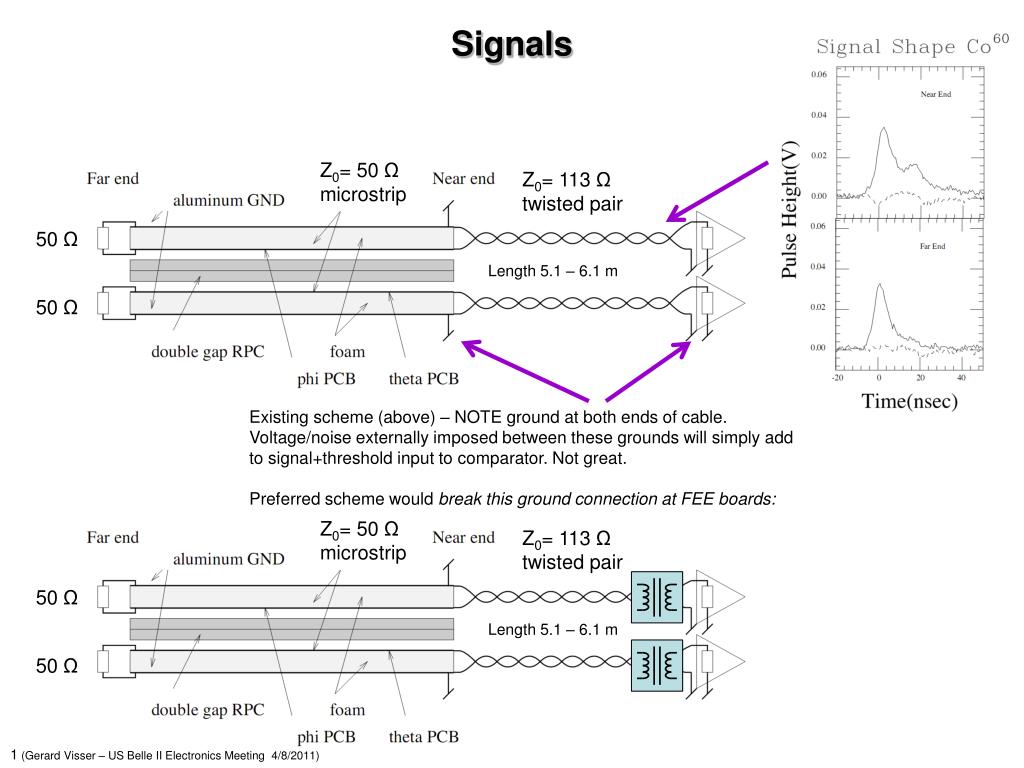
Ideal Grounding Scheme for 50Ω Microstrip and Twisted Pair Signal Transmission

This document discusses the impedance configurations for a 50Ω microstrip and a 50Ω twisted pair cable spanning lengths between 5.1 to 6.1 meters. It highlights the existing grounding scheme where both cable ends are grounded, which can introduce noise and voltage interference to the signal threshold at the comparator input. The preferred approach is suggested to involve breaking this ground connection at the Field Effect Transistor (FEE) boards to mitigate external voltage/noise influence, enhancing signal integrity during transmission.
Télécharger la présentation 
Politique de téléchargement : le contenu du site vous est fourni TEL QUEL pour votre information et votre usage personnel ; il ne peut être vendu, concédé sous licence ni partagé sur d’autres sites sans l’accord de son auteur.Le contenu vous est fourni TEL QUEL, pour votre information et votre usage personnel uniquement. Téléchargez la présentation en cliquant sur ce lien. Lors du téléchargement, si vous ne parvenez pas à télécharger une présentation, l’éditeur a peut-être supprimé le fichier de son serveur.Pendant le téléchargement, si vous ne parvenez pas à obtenir une présentation, le fichier a peut-être été supprimé par l’éditeur.
F I N