
SlideServe
Menu
Préférences
© SlideServe · v2026

Thunderstorm and stratocumulus: How does

kesler avatar
20 diapositives · 391 Views · Sep 23, 2014

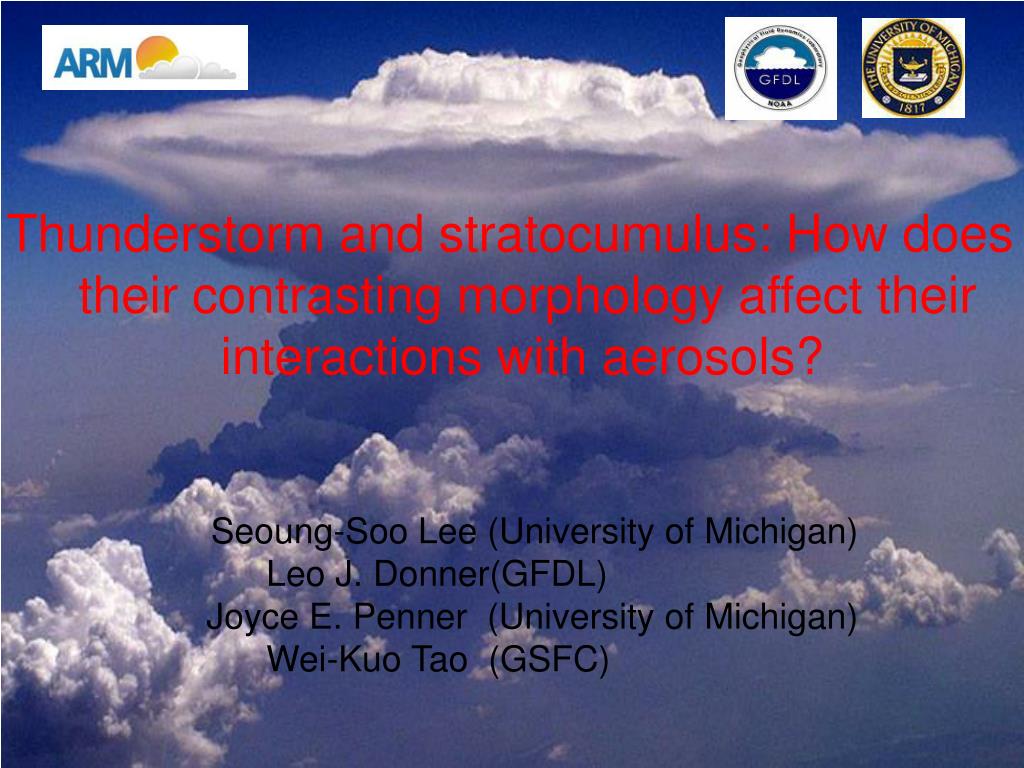
Thunderstorm and stratocumulus: How does their contrasting morphology affect their interactions with aerosols?. Seoung-Soo Lee (University of Michigan) Leo J. Donner(GFDL) Joyce E. Penner (University of Michigan)
Thunderstorm and stratocumulus: How does - slide 1
01 / 20Thunderstorm and stratocumulus: How does
1 / 17

Télécharger la présentation

Thunderstorm and stratocumulus: How does
Une image / un lien ci-dessous est fourni (tel quel) pour télécharger la présentation

Politique de téléchargement : le contenu du site vous est fourni TEL QUEL pour votre information et votre usage personnel ; il ne peut être vendu, concédé sous licence ni partagé sur d’autres sites sans l’accord de son auteur.Le contenu vous est fourni TEL QUEL, pour votre information et votre usage personnel uniquement. Téléchargez la présentation en cliquant sur ce lien. Lors du téléchargement, si vous ne parvenez pas à télécharger une présentation, l’éditeur a peut-être supprimé le fichier de son serveur.Pendant le téléchargement, si vous ne parvenez pas à obtenir une présentation, le fichier a peut-être été supprimé par l’éditeur.

F I N

Plus de contenu associé

Transcription de la présentation
  1. Thunderstorm and stratocumulus: How does their contrasting morphology affect their interactions with aerosols? Seoung-Soo Lee (University of Michigan) Leo J. Donner(GFDL) Joyce E. Penner (University of Michigan) Wei-Kuo Tao (GSFC)

  2. Motivation • Aerosol enhances precipitation in convective clouds, contrary to the well-known precipitation supprression in warm stratiform clouds • Delayed autoconversion increases latent-heat release from freezing,leaing to the invigoration of convection and precipitation enhancement (Rosenfeld et al., 2008) • However, the precipitation enhancement can be simulated in the absence of freezing through the intensification of gustiness (Lee et al., (2008a,b))

  3. These studies indicate a possible interplay between aerosol effects on ice physics and aerosol effects on gustiness • Lee et al. (2008) showed aerosol effects on gustiness were stronger in deeper clouds • The interplay may depend on cloud type

  4. Goal • The study aims to gain an understanding of the dependence of the interplay between aerosol effects on gust front and those on ice physics for precipitation enhancement on the types of convective clouds • This study also examines mechanisms which differentiate the precipitation response to aerosols in convective clouds from that in warm stratiform clouds

  5. Model Description  Goddard Cumulus Ensemble (GCE) model coupled with Saleeby and Cotton’s [2004] double-moment microphysics is used • Full stochastic collection solutions with realistic collection kernels are employed Sedimentation of hydrometeors is simulated by emulating a full-bin model with 36 bins

  6. Cases DEEP # A case of deep convective clouds Observed during the ARM sub-case A (13:30 UTC June 29th – 13:30 UTC June 30th 1997) campaign at (36.61N, 97.49W) MID # A case of shallow convective clouds Identical to DEEP but with lower surface humidity, leading to lower CAPE and thus cloud-top height

  7. STRATIFORM # A case of stratocumulus clouds Identical to DEEP but with strong temperature forcing around 1 km, generating an inversion layer and thus leading to the formation of stratocumulus clouds # Average aerosol number at the surface (cm-3) ◦High-aerosol run : ~ 4000 ◦Low-aerosol run: ~ 400

  8. Model Setup DEEP and MID 3D framework (168 km x 168 km x 20 km) is used ∆x and ∆y = 200 m and ∆z = 100 m STRATIFORM 3D framework (12 km x 12 km x 20 km) is used ∆x and ∆y = 50 m and ∆z = 40 m

  9. qc qi Cumulative precipitation (mm) Mixing ratio of cloud particles (g kg-1) DEEP With ice #High-Aerosol: 34.2 #Low-Aerosol: 29.9 With no ice #High-Aerosol: 31.5 #Low-Aerosol: 28.1 Height (km) x(km) MID With ice #High-Aerosol: 6.5 #Low-Aerosol: 5.3 With no ice #High-Aerosol: 4.2 #Low-Aerosol: 5.0 FAFAFAFA AFAFA AFAFAF Height (km) x(km) x(km)

  10. Cumulative precipitation (mm) Mixing ratio of cloud particles (g kg-1) STRATIFORM Ice (NOT formed) #High-Aerosol: 0.08 #Low-Aerosol: 0.5 Height (km) x(km)

  11. Differences (High - Low) in domain averaged terms associated with low-level convergence More cloud liquid and evaporative cooling More, stronger downdrafts

  12. DEEP 2) Low aerosol 1) High aerosol

  13. MID 2) Low aerosol 1) High aerosol

  14. SHALLOW 1) High aerosol 2) Low aerosol

  15. Summary and Conclusion • In deep convective clouds with tops reaching above the level of homogeneous freezing, the effect of aerosols on gust front alone can increase precipitation. • In shallow convective clouds with tops below the level of homogeneous freezing, the effect of aerosols on ice physics is necessary for the precipitation enhancement at high aerosol. • In warm stratiform clouds with no freezing and no well-developed gust front, precipitation is supresssed at high aerosol. • Possible increases in CAPE with the increasing greenhouse gases act in favor of the role of the aerosol effects on gustiness.

  16.  Aerosol induced changes in cloud-scale interactions between microphysics and dynamics were effective in deep convective clouds  These changes involves those in the cloud-system instability; an associated change in Thermodynamic Forcing (TF) is 125 W m-2.  Although these changes do not affect the net energy budget in the Earth, they can modify the vertical temperature gradient  Systems like the Indian and Asian Monsoon, storm tracks, and ITCZ, playing important roles in global circulations, are driven by deep convective clouds.

  17.  Lee et al. (2009) and Lee and Penner (2009) showed that cumulus parameterization (CP) was not able to simulate changes in the instability induced by cloud-scale motions; generally, CP only considers these changes induced by large-scale forcings Thanks !!

  18. Possible increases in CAPE with the increasing greenhouse gases act in favor of the role of the aerosol effects on gustiness.  Cloud-scale interactions between microphysics and dynamics modified environmental instability effectively in deep convective clouds  Aerosol-induced changes in the instability is associated with a substantial change in latent-heat distribution; an associated change in Thermodynamic Forcing (TF) is 125 W m-2.

  19.  Although these changes do not affect the net energy budget in the Earth, they can modify global water and dynamic circulations significantly  Systems like the Indian and Asian Monsoon, storm tracks, and ITCZ, playing important roles in global circulations, are driven by deep convective clouds.

  20. Thanks !!