Download
1 / 7
70 likes | 209 Vues
This tutorial provides an in-depth exploration of parametric equations in calculus, focusing on the representation of curves in the xy-plane through continuous functions. We define parametric equations where x = f(t) and y = g(t) over an interval of t-values, outlining how these equations represent a path traced by a particle. The process of parameterization is explained, along with methods to determine the slope of the tangent line using the chain rule. Learn how to analyze curves that cannot be expressed as traditional functions of x or y.

E N D
12.1 Parametric Equations Math 6B Calculus II
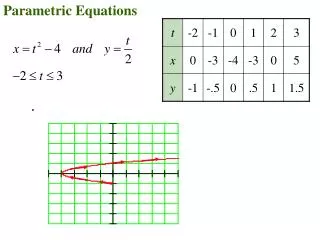
Parametrizations and Plane Curves • Path traced by a particle moving alone the xy plane. Sometimes the graph cannot be expressed as a function of x or y.
Definition • If x and y are continuous functions x = f (t) , y = g(t) over an interval of t – values , then the set of points (x , y) = ( f (t) , g(t)) defined by these equations is a curvein the coordinate plane.
Definition • The equations are parametric equations. The variable t is a parameter for the curve and its domain I is the parameter interval. If I is a closed interval, , the pt. ( f (a) , g(a)) is the initial point of the curve and ( f (b) , g(b)) is called the terminal point of the curve.
Definition • When we give parametric equations and a parameter interval for a curve in the plane, we say that we have parameterized the curve. The equations and interval constitute a parameterization of the curve.
Tangents • To find the slope of the tangent dy/dx from the parametric equations x = f (t) and y = g (t), let us use the chain rule of dy/dt
Tangents • We can get dy/dx by itself and therefore get the slope of the tangent line.