Ingomar Elementary Review Game
320 likes | 448 Vues
Engage your students with Mrs. Koseski's Chapter 18 Science Review Game, focusing on gravity's effects on planetary movements, the unique features of different planets, and the characteristics that support life on Earth. This interactive quiz covers key concepts such as the Great Red Spot on Jupiter, the rings of Saturn, and the gas giants. Students will deepen their understanding of planetary science while having fun. Ideal for reinforcing knowledge in a captivating way, this game is perfect for classroom activities or study sessions.


Ingomar Elementary Review Game
E N D
Presentation Transcript
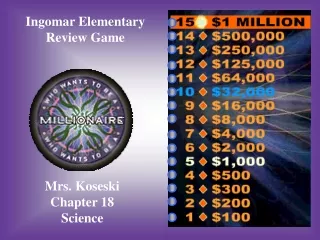
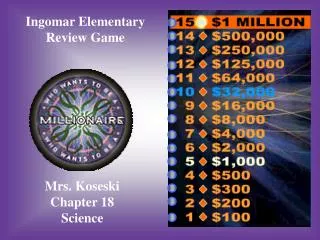
Ingomar Elementary Review Game Mrs. Koseski Chapter 18 Science
#1 How does gravity affect the movement of planets? Keeps paths circular Keeps paths straight A: B: Keeps paths angular Does not affect paths C: D:
#2 Name this planet- Inner planet with two moons, sometimes has huge dust storms, rocks and soil rich with iron Mercury Venus A: B: Earth Mars C: D:
#3 What is the cause of the Great Red Spot on Jupiter? Volcano Iron A: B: Storm High temperatures C: D:
#4 The ___________ around Saturn are made of water, ice, dust, and chunks of rock. Planets Moons A: B: Rings Stars C: D:
#5 Which planet has the greatest number of moons? Jupiter Neptune A: B: Venus Saturn C: D:
#6 How is Uranus different from other gas giants? Crosses orbit with others Has rings and many moons A: B: Larger than other gas giants Rotates on its side C: D:
#7 What two features make life possible on Earth? Liquid water and oxygen Atmosphere and liquid water A: B: Atmosphere and oxygen Carbon dioxide and liquid water C: D:
#8 What is the name for the study of objects in space? Astrology Astronomy A: B: Biology Physics C: D:
#9 What planet is very hot during the daytime and very cold at night due to its lack of atmosphere? Mercury Venus A: B: Earth Mars C: D:
#10 Which planet has thick clouds that reflect the Sun’s light and make it one of the brightest objects in the sky? Mercury Venus A: B: Jupiter Uranus C: D:
#11 Which planet has a moon named Titan? Venus Mars A: B: Saturn Uranus C: D:
#12- Compared to the other gas giants, Neptune is _____________. Larger Smaller A: B: The same size Not a gas giant C: D:
#13 Which of these is not a gas giant? Jupiter Neptune A: B: Saturn Earth C: D:
#14 Which planet is surrounded by hot, poisonous gases and is too hot for life as we know it to exist. Mercury Earth A: B: Venus Neptune C: D:
#15 About 60 Earths could fit inside this gas giant. Neptune Jupiter A: B: Saturn Uranus C: D:
Great Job!!!! Thank you for playing!