Enzymes are Important Proteins
100 likes | 225 Vues
This presentation explores the vital role of enzymes in biological processes. Enzymes act as biological catalysts, accelerating reactions by lowering activation energy while remaining unchanged themselves. Learn how enzymes interact with substrates through the “lock and key” model and discover how factors like temperature and pH can cause enzymes to denature. Visual aids, including diagrams of enzyme reactions, help to illustrate these concepts. By the end, you will have a comprehensive understanding of enzyme function, their reactions, and the conditions that affect their efficiency.


Enzymes are Important Proteins
E N D
Presentation Transcript
Enzymes are Important Proteins Cornell Trick it out!
Learning Goals… • Describe the function of enzymes a.k.a biological catalyst. • Draw a picture of an enzyme reaction. • Decide how it is that enzymes get denatured.
A.. Enzymes Function • Speed up reactions by lowering the activation energy. • They remain unchanged in a rxn • Enzymes are not used up by rxn G:\Biology Folders\macromolecules\Enzymes are Important Proteins.ppt
B. What are the parts of a chemical reaction? Reactant 1 reactant 2 products CO2 + H2O H2CO2
C. What is the activation energy? • It’s the energy need to start the reaction.
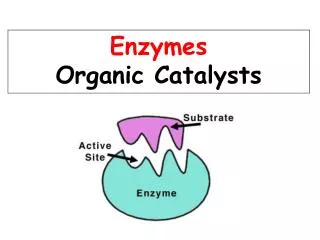
E. Enzyme Action • Enzymes have specific binding site where the enzyme and substrate bond. • They can build or break up bonds . • Known as “ LOCK AND KEY” model, substrate and enzyme fit perfectly.
F. Enzymes get Denatured! • Enzymes have a shape that allows it to fit a substrate. • This shape can be changed or denatured by … 1. change in temperature (cool, hot) 2. change in pH (addition of H+ ions or OH- ions). “think melted key”
Let review!!! • http://www.dannynicholson.co.uk/enzymetale.swf • http://www.coolschool.ca/lor/BI12/unit7/U07L04/tt1contents.htm
Summary • Respond to the learning goals.