Understanding Proteins and Enzymes: Their Structure, Function, and Role in Biological Reactions
Proteins are essential organic compounds made up of carbon, hydrogen, oxygen, and nitrogen. Composed of amino acids, proteins serve as key building blocks for skin, muscles, and enzymes. With 20 different amino acids, their unique "R" groups create diverse shapes and functions. Proteins form via condensation reactions, resulting in peptide bonds that connect amino acids into longer polypeptide chains. Enzymes, a type of protein, act as catalysts, speeding up reactions by lowering activation energy. Their activity is influenced by factors such as temperature and pH.

Understanding Proteins and Enzymes: Their Structure, Function, and Role in Biological Reactions
E N D
Presentation Transcript
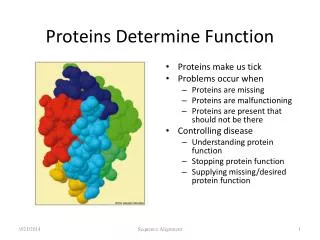
What are proteins? • Proteins are organic compounds composed of carbon, hydrogen, oxygen, & nitrogen • C, H, O, N • Skin, muscles, catalysts
Protein monomers (building blocks) • Proteins are made from amino acids • There are 20 different amino acids
Amino Acid Structure • The “R” group is what makes the amino acids different • Different amino acids have different SHAPES and FUNCTIONS
Protein Condensation • Condensation is adding two or more amino acids together. • The result is a DIPEPTIDE & WATER
Peptide Bonds • The C-N bond is called a peptide bond • Peptide bonds are created during condensation reactions
Polypeptides • 3 or more amino acids • Usually long chains
Proteins • 1 or more polypeptides make up a PROTEIN
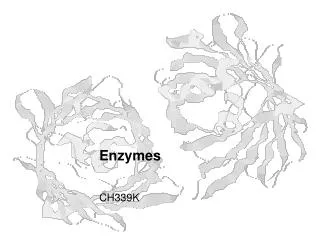
Enzymes • Enzymes are organic molecules (proteins) that are catalysts • This means they speed up a reaction by lowering the activation energy • The energy needed for a reaction to take place
Enzymes & Substrate • Enzymes have an activation site that a substrate binds to • The reaction occurs, and the new products are released from the enzyme
More abt Enzymes • Enzymes are unchanged, so they can be used multiple times • Enzyme activity depends on many factors • pH • temperature