
SlideServe
Menu
Préférences
© SlideServe · v2026

Understanding Evolution: Darwin's Natural Selection Reasoning
khunt avatar
27 diapositives · 572 Views · Jan 03, 2020

Explore Darwin's reasoning behind natural selection, learn about evolution, species, selective breeding, and how natural selection leads to adaptation and biodiversity. Discover the impact of environmental factors on survival and the importance of genetic variation.
Understanding Evolution: Darwin's Natural Selection Reasoning - slide 1
01 / 27Understanding Evolution: Darwin's Natural Selection Reasoning
1 / 17

Télécharger la présentation

Understanding Evolution: Darwin's Natural Selection Reasoning
Une image / un lien ci-dessous est fourni (tel quel) pour télécharger la présentation

Politique de téléchargement : le contenu du site vous est fourni TEL QUEL pour votre information et votre usage personnel ; il ne peut être vendu, concédé sous licence ni partagé sur d’autres sites sans l’accord de son auteur.Le contenu vous est fourni TEL QUEL, pour votre information et votre usage personnel uniquement. Téléchargez la présentation en cliquant sur ce lien. Lors du téléchargement, si vous ne parvenez pas à télécharger une présentation, l’éditeur a peut-être supprimé le fichier de son serveur.Pendant le téléchargement, si vous ne parvenez pas à obtenir une présentation, le fichier a peut-être été supprimé par l’éditeur.

F I N

Plus de contenu associé

Transcription de la présentation
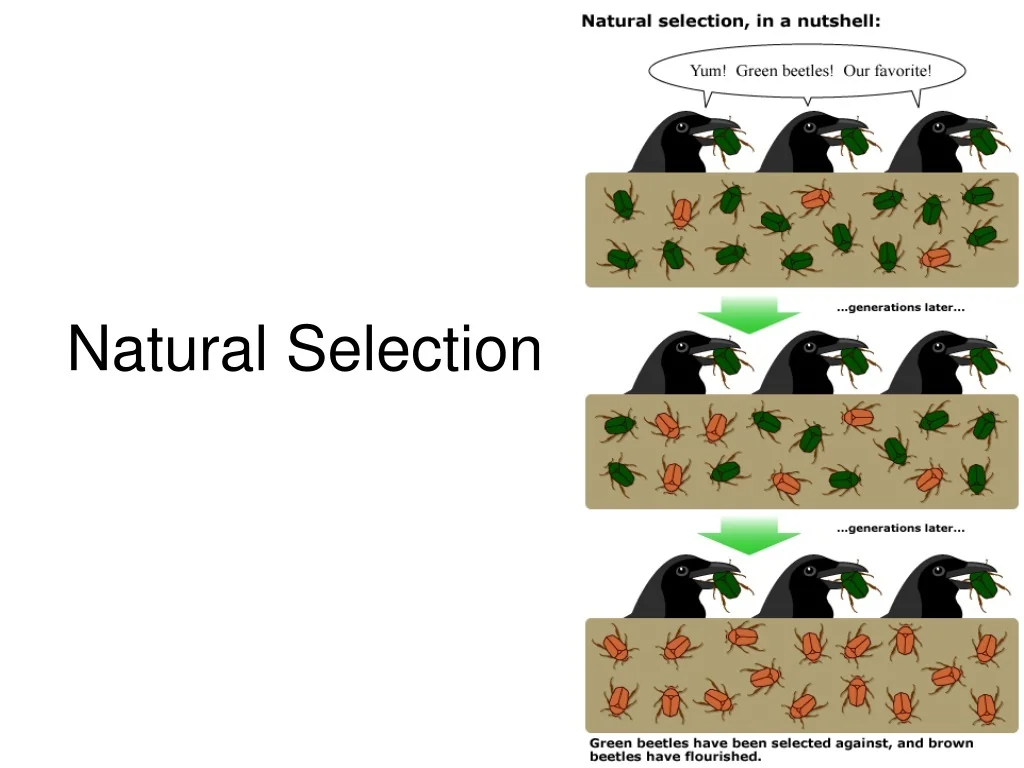
  1. Natural Selection

  2. What was Darwin’s reasoning? • Plants and animals that arrived on the Galapagos faced environmental factors that were different from the mainland. • Species gradually changed over many generations and became better adapted to the new environment.

  3. What is evolution? • The gradual change in a species over a long period of time

  4. What is a species? • A group of similar organisms that can mate and produce fertile offspring.

  5. What is selective breeding? • The practice by which humans select plants or animals for breeding based on desired traits. • Ex: dogs

  6. What is natural selection? • The process in which individuals that are better adapted to their environment are more likely to survive and reproduce than other members of the same species.

  7. What are four factors that affect natural selection? • Example: Sea Turtles! • Environment → • Adaptations 1. 2. 3.

  8. Overproduction • organisms produce more offspring than can survive. • Ex: too many sea turtles!

  9. 2. Variation • Each individual has its own unique combination of traits. Similar but not identical. • Ex: some turtles are faster than others

  10. 3. Competition (Struggle to Survive) • Some may get caught by predators or starve or get disease. Only some make it to adulthood. • Ex: not enough food + predators

  11. Selection • Turtles that are best adapted to their environment are likely to have many offspring that survive.

  12. Can natural selection lead to evolution? • YES! Over a long period of time natural selection can lead to change. • Helpful variations increase while harmful variations decrease. • Nature “selects” characteristics.

  13. What are environmental factors? • Things in the environment that can affect an organism’s ability to survive. • Ex: predators and food supply

  14. What about genetic variation? • Individuals need to be different for natural selection to work, otherwise, all individuals would have an equal chance of survival!

  15. Example of natural selection: • Peppered moth variation: black form and white form environment: trees in England