Understanding Natural Selection: Mechanisms, Evidence, and Evolutionary Change
This educational overview delves into the principles of natural selection and how populations evolve over time. It explores variations in traits, reproductive strategies, and environmental pressures that influence survival. Observations made by Charles Darwin, particularly in the Galapagos Islands, laid the groundwork for understanding adaptations and speciation. Key concepts include types of adaptations, evidence for evolution, the mechanics of evolution, and the processes behind the emergence of new species. Gain insights into gradual and punctuated evolution, population dynamics, and the role of genetic diversity.

Understanding Natural Selection: Mechanisms, Evidence, and Evolutionary Change
E N D
Presentation Transcript
Today’s Objectives: SOL BIO.8b-d • TSW investigate and understand how populations change through time, including: • How variation of traits, reproductive strategies, and environmental pressures impact on the survival of populations • Recognizing how adaptations lead to natural selection • How new species emerge
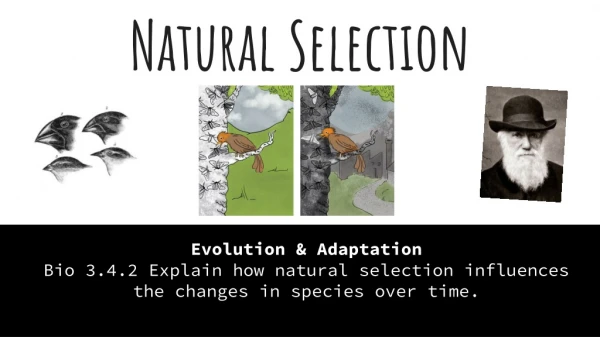
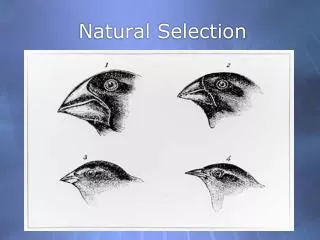
Charles Darwin • On the Origin of Species • Sailed with the HMS Beagle • Observations made in the Galapogos Islands • These observations helped him form the theory of how species change over time called natural selection
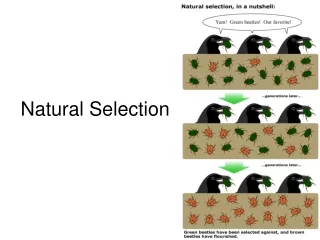
What is Natural Selection? • Natural selection is governed by the principles of genetics.
Types of Adaptations • Protective Coloring • Camouflage • Mimicry • Physiological Adaptations • Reproductive Changes • Other changes • Behavioral Adaptations
Evidence for Evolution • Fossil record • Anatomy • Homologous structures • Analagous structures • Vestigial structures • Embryology • Molecular biology (DNA differences)
What is a Population? • Populations evolve over many generations, individuals don’t • Populations are groups of interbreeding individuals that live in the same place at the same time • Individuals in a population compete for resources with each other
How Does Evolution Work? • Populations produce more offspring than the environment can support • The unequal ability of individuals to survive and reproduc leads to the gradual change in a population over many generations
Mechanism for change in a population of organisms • Animals who have greater fitness survive in environment and live to reproduce • Random changes (mutations) can lead to greater or less fitness • Adaptations allow an organism to survive better in their environment
Mutations & Variety Produced by Sexual Reproduction Allow for Diversity within a Population • Genetic drift (caused by chance) • Bottleneck • Founder effect • Genetic equilibrium • Hardy-Weinberg law • In H-W equilibrium, does not occur
Adaptations • Can arise in response to environmental pressures • Temperature • Antibiotic resistance in bacteria • Pesticide resistance • Morphological changes in peppered moths
Types of Selection • Directional • Extreme form favored by natural selection • Stabilizing • Middle form most successful • Disruptive • Two extreme forms successful in separate environments
How are new species created? • Geographic isolation • Reproductive barriers • Change in chromosome numbers • Adaptive radiation
Types of Evolution • Convergent evolution • Dolphins & fishes • Wings of bees & bats • Divergent evolution • Darwin’s finches • Adaptive radiation
How fast does evolution occur? • Gradualism • Darwin • Species change slowly over time • Punctuated Equilibrium • Gould & Lewontin • Species can make rapid “leaps” in evolution • Modern Synthesis • Parts of both are correct