Download
1 / 2
20 likes | 143 Vues
Aliya Hussein's dressmaking business has expanded significantly over three years, moving from a one-person operation to a team of seven, including four full-time employees. While staying committed to job production and custom orders, Aliya considers investing in more machinery and standard dress lines to enhance efficiency. However, her current model proves profitable, with satisfied customers. This case reflects on what 'efficient production' means for her business, potential benefits of increased efficiency, and an evaluation of the appropriateness of her job production approach.

E N D
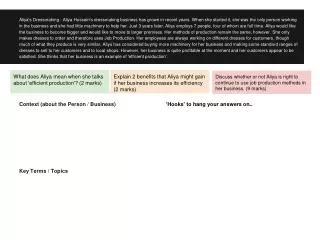
'Hooks' to hang your answers on.. Aliya's Dressmaking - Aliya Hussein's dressmaking business has grown in recent years. When she started it, she was the only person working in the business and she had little machinery to help her. Just 3 years later, Aliya employs 7 people, four of whom are full time. Aliya would like the business to become bigger and would like to move to larger premises. Her methods of production remain the same, however. She only makes dresses to order and therefore uses Job Production. Her employees are always working on different dresses for customers, though much of what they produce is very similar, Aliya has considered buying more machinery for her business and making some standard ranges of dresses to sell to her customers and to local shops. However, her business is quite profitable at the moment and her customers appear to be satisfied. She thinks that her business is an example of 'efficient production'. Context (about the Person / Business) Key Terms / Topics What does Aliya mean when she talks about 'efficient production'? (2 marks) Explain 2 benefits that Aliya might gain if her business increases its efficiency (2 marks) Discuss whether or not Aliya is right to continue to use job production methods in her business. (9 marks)