Interactive Chair Design for Enhanced Window Seat Visual Experience
This project explores using a rocking chair to enhance visual experiences of remote locations. It compares rocking chair interface with HMD and CAVE setups, detailing components and sensor mechanisms for immersive interaction. Future work includes chair swiveling and exploring distant spatial locations.

Interactive Chair Design for Enhanced Window Seat Visual Experience
E N D
Presentation Transcript
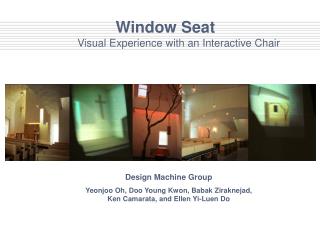
Window SeatVisual Experience with an Interactive Chair Design Machine Group Yeonjoo Oh, Doo Young Kwon, Babak Ziraknejad, Ken Camarata, and Ellen Yi-Luen Do
Outline - Introduction - Related Work - Window Seat Design - Demonstration - Discussion
Introduction Interactive Chair How can a rocking chair be used to mediate the visual experience of a remote location? Ordinary person’s virtual reality interfacevs. HMD (Head-mounted Display), CAVE Scenario Architectural scale model (St. Ignatius Chapel)
Related Work Virtual Reality Navigation - HMD (Head-mounted Display) - CAVE - Desktop VR CAVE HMD Desktop VR
Related Work Tangible Media - Bricks - metaDESK & DigitalDesk metaDESK & DigitalDesk (Newman, W., and Wellner, P., 1992) Bricks (Fitzmautice, G., Ishii, H., and Buxton, W., 1995)
Window Seat 1. Physical Chair/ 2. Handyboard 3. Wall as Display Device 4. Projector/ 5. Remote Camera Chairware Components 1 3 2 4 2 5
Window Seat Two Sensors Pressure Sensors Variable resistors/ Pan (right & left) Infrared Sensor Range finder/ Tilt (up & down)
Window Seat Movement of Camera: Servo Motors : Two attached servo motors at a right angle : Pan (right & left) Tilt (up & down)
Window Seat in Action Immersion Experience
Window Seat in Action Immersion Experience
Discussion & Future Work - Simple idea - Explore the potential of creating real immersion sensation Future Work - Swiveling chair - Camera position - Remote Location: molecular space, distant space