Understanding Heat Changes: Thermochemical Equations and Calorimetry
In this section, we explore the principles of calorimetry and thermochemical equations. Learn how to write and interpret thermochemical equations that reflect heat changes in chemical and physical processes. Discover the concepts of enthalpy, including how to calculate changes in enthalpy (∆H) under constant pressure conditions. We also differentiate between endothermic and exothermic reactions and describe the use of coffee cup and bomb calorimeters for precise heat measurements. Gain a comprehensive understanding of heat content in various reactions.


Understanding Heat Changes: Thermochemical Equations and Calorimetry
E N D
Presentation Transcript
Measuring heat changes Section 11.2
After reading Section 11.2, you should know: • How to write or interpret a thermochemical equation • How to calculate heat changes in a chemical or physical process
Calorimetry • Calorimetry – the accurate and precise measurement of heat changes which occur during chemical and physical processes.
Enthalpy • Enthalpy (H) – measure of the heat content of a system. • ∆H – change in enthalpy at constant pressure • For reactions which take place at constant pressure, the terms heat and enthalpy are used interchangeably, that is, q = ∆H. • q = ∆H = (m)(Cp)(∆T)
Calorimeters • Coffee cup calorimeter – an insulated device used to measure the absorption or release of heat of a reaction at constant pressure. • Bomb calorimeter – used for measuring heat released when a compound is burned at constant volume.
Thermochemical Equations • Thermochemical equation – an equation which includes the heat of the reaction • The physical state of all reactants and products must also be stated • The energy absorbed or released in a chemical equation can be expressed in two different ways: • As a reactant or product or • Using the symbol ΔH
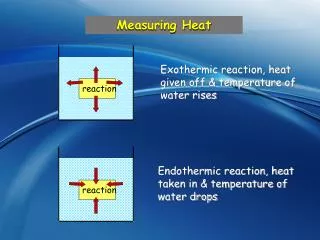
Thermochemical Equations Endothermic reaction (heat is a absorbed, so it is a reactant): 2 NaHCO3(s) + 129 kJ → Na2CO3(s) + CO2(g) + H2O(g) OR 2 NaHCO3(s) → Na2CO3(s) + CO2(g) + H2O(g) ∆H = +129 kJ
Thermochemical Equations Exothermic reaction (heat is given off, so it is a product): CaO(s) + H2O(l) → Ca(OH)2(s) + 65.2 kJ OR CaO(s) + H2O(l) → Ca(OH)2(s) ∆H = − 65.2 kJ
After reading Section 11.2, you should know: • How to write or interpret a thermochemical equation • How to calculate heat changes in a chemical or physical process