Heat Changes in Chemical Reactions
260 likes | 424 Vues
Explore the measurement and expression of heat changes in chemical reactions using calorimetry and thermochemical equations. Learn how enthalpy relates to energy changes and reactions.


Heat Changes in Chemical Reactions
E N D
Presentation Transcript
Section 11.2Measuring and Expressing Heat Changes • OBJECTIVES: • Construct equations that show theheat changes for chemical and physical processes. 1
Section 11.2Measuring and Expressing Heat Changes • OBJECTIVES: • Calculate heat changes in chemical and physical processes. 2
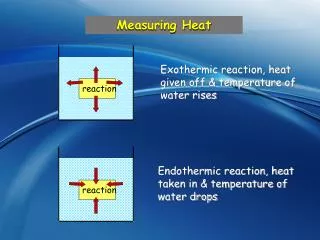
Calorimetry • Calorimetry - the accurate and precise measurement of heat change for chemical and physical processes. • The device used to measure the absorption or release of heat in chemical or physical processes is called a Calorimeter
Calorimetry • Foam cups are excellent heat insulators, and are commonly used as simple calorimeters • Fig. 11.8, page 300 • For systems at constant pressure, the heat content is the same as a property called Enthalpy (H) of the system
Calorimetry • Changes in enthalpy = ΔH • q = ΔH These terms will be used interchangeably in this textbook • Thus, q = ΔH = m x C x ΔT • ΔH is negative for an exothermic reaction • ΔH is positive for an endothermic reaction (Note Table 11.3, p.301)
Calorimetry • Calorimetry experiments can be performed at a constant volume using a device called a “bomb calorimeter” - a closed system • Figure 11.9, page 301 • Sample 11-2, page 302
C + O2 C O2 C + O2→ CO2 + 395 kJ Energy 395kJ Reactants → Products 7
O O O O C In terms of bonds C C O O O C O Breaking this bond will require energy. Making these bonds gives you energy. In this case making the bonds gives you more energy than breaking them. 8
Exothermic • The products are lower in energy than the reactants • Releases energy 9
CaO + CO2 CaCO3 CaCO3 + 176 kJ → CaO + CO2 CaCO3→ CaO + CO2 Energy 176 kJ Reactants → Products 10
Endothermic • The products are higher in energy than the reactants • Absorbs energy • Note Figure 11.11, page 303 11
Chemistry Happens in MOLES • An equation that includes energy is called a thermochemical equation • CH4 + 2O2→ CO2 + 2H2O + 802.2 kJ • 1 mole of CH4 releases 802.2 kJ of energy. • When you make 802.2 kJ you also make 2 moles of water 12
Thermochemical Equations • A heat of reaction is the heat change for the equation, exactly as written • The physical state of reactants and products must also be given. • Standard conditions for the reaction is 101.3 kPa (1 atm.) and 25 oC 13
CH4 + 2 O2→ CO2 + 2 H2O + 802.2 kJ • If 10. 3 grams of CH4 are burned completely, how much heat will be produced? 1 mol CH4 802.2 kJ 10. 3 g CH4 16.05 g CH4 1 mol CH4 = 514 kJ 14
CH4 + 2 O2→ CO2 + 2 H2O + 802.2 kJ • How many liters of O2 at STP would be required to produce 23 kJ of heat? • How many grams of water would be produced with 506 kJ of heat? 15
Examples • When 2 mol of solid magnesium (Mg) combines with 1 mol of oxygen gas (O2), 2 mol of solid magnesium oxide (MgO) is formed and 1204 kJ of heat is released. Write the thermochemical equation for this reaction. 16
Enthalpy • The heat content a substance has at a given temperature and pressure • Can’t be measured directly because there is no set starting point • The reactants start with a heat content • The products end up with a heat content • So we can measure how much enthalpy changes 18
Enthalpy • Symbol is H • Change in enthalpy is ΔH (delta H) • If heat is released, the heat content of the products is lower ΔH is negative (exothermic) • If heat is absorbed, the heat content of the products is higher ΔH is positive (endothermic) 19
Energy Change is down ΔH is <0 Reactants → Products 20
Energy Change is up ΔH is > 0 Reactants → Products 21
Heat of Reaction • The heat that is released or absorbed in a chemical reaction • Equivalent to ΔH • C + O2(g) → CO2(g) + 393.5 kJ • C + O2(g) → CO2(g) ΔH = -393.5 kJ • In thermochemical equation, it is important to indicate the physical state • H2(g) + 1/2O2 (g)→ H2O(g) ΔH = -241.8 kJ • H2(g) + 1/2O2 (g)→ H2O(l) ΔH = -285.8 kJ 22
Heat of Combustion • The heat from the reaction that completely burns 1 mole of a substance • Note Table 11.4, page 305 23