
SlideServe
Menu
Préférences
© SlideServe · v2026

Use of comma after introductory participial phrase

kimberly-stephens avatar
10 diapositives · 401 Views · Nov 05, 2014

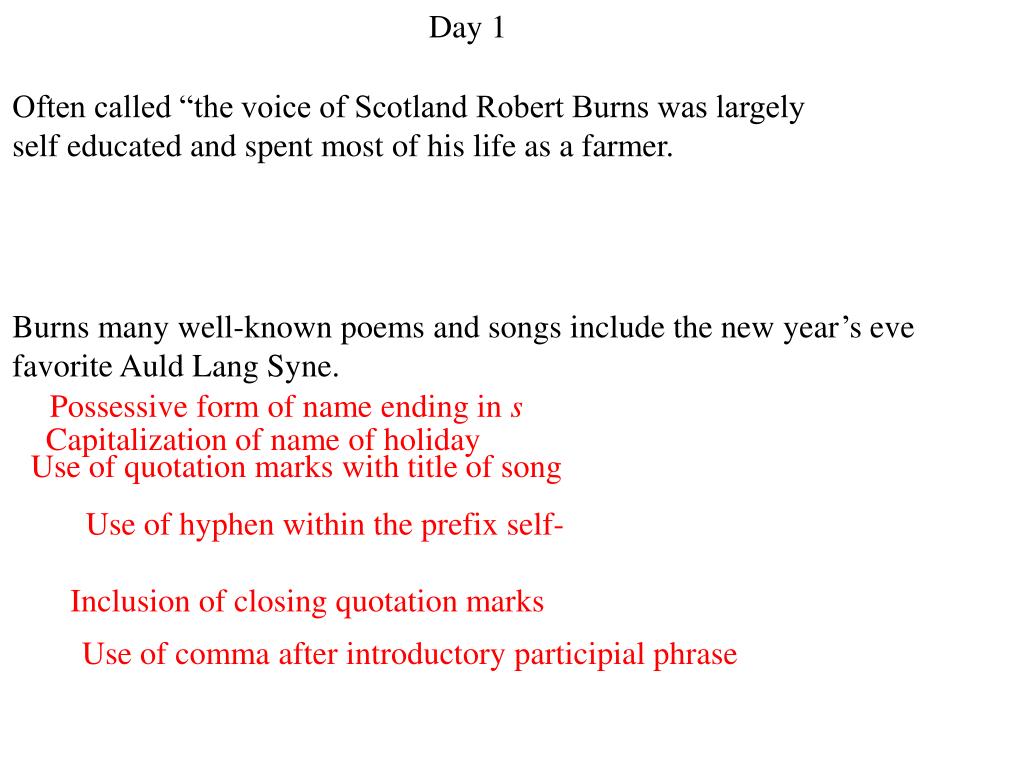
Day 1. Often called “the voice of Scotland Robert Burns was largely self educated and spent most of his life as a farmer. Burns many well-known poems and songs include the new year’s eve favorite Auld Lang Syne. Possessive form of name ending in s. Capitalization of name of holiday.
Use of comma after introductory participial phrase - slide 1
01 / 10Use of comma after introductory participial phrase
1 / 17

Télécharger la présentation

Use of comma after introductory participial phrase
Une image / un lien ci-dessous est fourni (tel quel) pour télécharger la présentation

Politique de téléchargement : le contenu du site vous est fourni TEL QUEL pour votre information et votre usage personnel ; il ne peut être vendu, concédé sous licence ni partagé sur d’autres sites sans l’accord de son auteur.Le contenu vous est fourni TEL QUEL, pour votre information et votre usage personnel uniquement. Téléchargez la présentation en cliquant sur ce lien. Lors du téléchargement, si vous ne parvenez pas à télécharger une présentation, l’éditeur a peut-être supprimé le fichier de son serveur.Pendant le téléchargement, si vous ne parvenez pas à obtenir une présentation, le fichier a peut-être été supprimé par l’éditeur.

F I N

Plus de contenu associé

Transcription de la présentation
  1. Day 1 Often called “the voice of Scotland Robert Burns was largely self educated and spent most of his life as a farmer. Burns many well-known poems and songs include the new year’s eve favorite Auld Lang Syne. Possessive form of name ending in s Capitalization of name of holiday Use of quotation marks with title of song Use of hyphen within the prefix self- Inclusion of closing quotation marks Use of comma after introductory participial phrase

  2. Day 1 Often called “the voice of Scotland,” Robert Burns was largely self-educated and spent most of his life as a farmer. Inclusion of closing quotation marks Use of comma after introductory participial phrase Use of hyphen within the prefix self- Burns’s many well-known poems and songs include the New Year’s Eve favorite "Auld Lang Syne." Possessive form of name ending in s Capitalization of name of holiday Use of quotation marks with title of song

  3. Day 2 Rebeling against formal eighteenth-century poetry, Burns wrote about everyday subjects, farm work, family life, and even mice and lice! His use of the Scottish dialect not only brought a much needed freshness to English poetry and honored common men and women. Use of correlation conjunction Use of hyphen in compound adjective Use of dash to set off additional information Correct spelling: doubling final consonant

  4. Day 2 Rebelling against formal eighteenth-century poetry, Burns wrote about everyday subjects-farm work, family life, and even mice and lice! Correct spelling: doubling final consonant Use of dash to set off additional information His use of the Scottish dialect not only brought a much-needed freshness to English poetry but also honored common men and women. Use of hyphen in compound adjective Use of correlation conjunction

  5. Day 3 Many of Burns’s lines, such as “the best laid schemes o’ mice and men/ gang aft agley,” have become familiar quotations. Capitalization of first word in a line of poetry “Gang aft agley” by the way is Scottish dialect for “often go wrong." Use of underlining or italics with foreign words Use of commas with interrupter

  6. Day 3 Many of Burns’s lines, such as “The best laid schemes o’ mice and men/ Gang aft agley,” have become familiar quotations. Capitalization of first word in a line of poetry Gang aft agley, by the way, is Scottish dialect for “often go wrong.” Use of underlining or italics with foreign words Use of commas with interrupter

  7. Day 4 Keenly interested in Scottish folk music, poems by Robert Burns were intended to be sung to traditional tunes. Not all of the poet’s work was in dialect, when dealing with more typical or respectable subject matter, Burns wrote in standard English. Use of active voice to improve style Correction of dangling modifier Use of semicolon to correct run-on sentences

  8. Day 4 Keenly interested in Scottish folk music, Burnsintended to sing his poems to traditional tunes. Correction of dangling modifier Use of active voice to improve style Not all the poet’s work was in dialect; when dealing with more typical or respectable subject matter, Burns wrote in standard English. Use of semicolon to correct run-on sentences

  9. Day 5 Robert Burns enjoyed a few seasons of fame, but suffered bad from poverty and illness all his life. No matter what the feelings in his heart Burns captured them in the versetile and vigorous language of his poetry. Elimination of unnecessary comma in compound construction Use of comma to set off absolute phrase Correction of commonly misspelled word Use of adverb to modify a verb

  10. Day 5 , Robert Burns enjoyed a few seasons of fame but suffered badly from poverty and illness all his life. Elimination of unnecessary comma in compound construction Use of adverb to modify a verb No matter what the feelings in his heart, Burns captured them in the versatile and vigorous language of his poetry. Use of comma to set off absolute phrase Correction of commonly misspelled word